Have Query ? Reach Out Us!

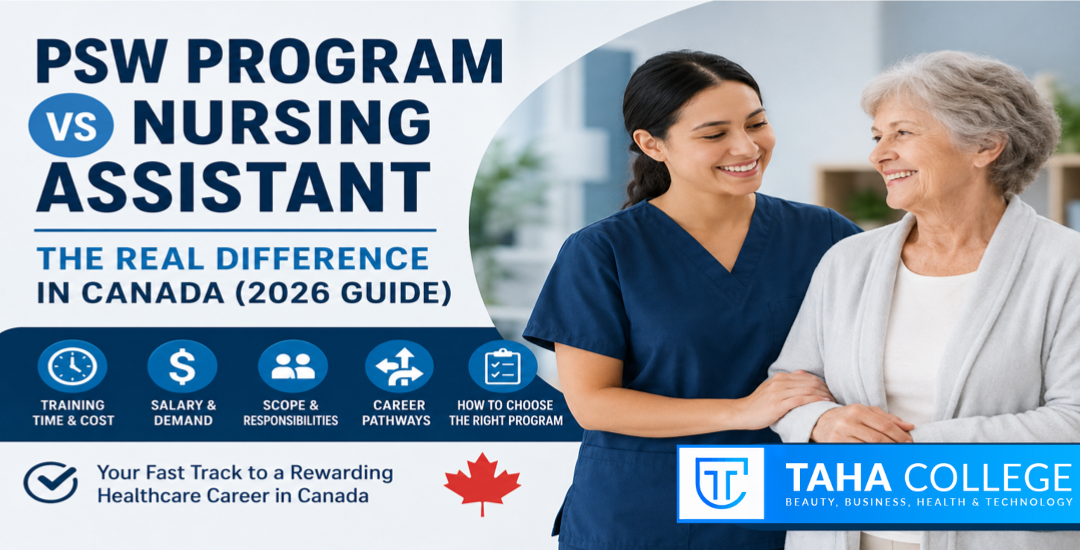
Difference between a PSW Program and Nursing Assistant in Canada
Here is the first thing nobody tells you when you search "PSW vs Nursing Assistant" in Canada: the job title "Nursing Assistant" barely exists here. If you are weighing a PSW Program against becoming a "Nursing Assistant," you are likely comparing a real Canadian credential against a label imported from the US or overseas. Sorting that out now will save you months and a lot of tuition money.
So let's clear the fog. Then we'll compare the actual paths, the real 2026 numbers, and how to pick a program that gets you hired.
In the United States you have the Certified Nursing Assistant, or CNA. Many countries use "Nursing Assistant" the same way. Canada does not.
Walk into any Ontario hospital or long-term care home and you will not find a role officially titled Nursing Assistant. What you will find instead are two clear lanes. One lane is the unregulated support worker, called a Personal Support Worker (PSW) in Ontario, a Health Care Aide in Alberta, and a Health Care Assistant in British Columbia. The other lane is the regulated nurse, either a Registered Practical Nurse (RPN) or a Registered Nurse (RN). The old term "nursing assistant" in Canada actually maps to what we now call the RPN, a fully licensed nurse, not an entry-level aide.
That single point changes everything. When most newcomers say "Nursing Assistant," what they can realistically train for in six to twelve months is the PSW role, not a nursing licence. A PSW Program is the fast, affordable, in-demand entry point. Calling it a "Nursing Assistant course" just confuses the search.
A PSW supports people with the activities that illness, age, or disability make hard. Bathing, dressing, grooming, feeding, mobility, and companionship. Real, hands-on care.
PSWs work in long-term care homes, retirement residences, hospitals, and increasingly in private homes through home care agencies. They do not diagnose, they do not perform medical procedures, and in most settings they do not administer medication, though they may remind and assist a client with their own. A nurse develops the care plan. The PSW carries out the daily personal care inside it. That distinction matters when you choose your path, because it defines your scope for your whole career.
This is where the decision actually gets made. Time, money, and what you can do once you finish.
Training time and cost
A PSW Program runs roughly 600 to 900 hours and finishes in about six to twelve months, including a supervised clinical placement . Tuition at a private career college in Toronto usually lands in the low thousands, not tens of thousands.
Compare that to nursing. An RPN diploma takes two years. An RN degree takes four. Both cost far more and demand a heavier academic load in pharmacology, anatomy, and clinical assessment. If you need to start earning quickly, the math favours the PSW route.
Salary and demand
Be honest with yourself about pay. In Toronto, PSW wages average around C$20 an hour in 2026, with Job Bank Canada reporting a broader range of roughly $18 to $28 depending on setting and seniority . Hospital and unionized long-term care jobs sit at the higher end and often add shift premiums and benefits.
Nurses earn more, no question. An RPN or RN out-earns a PSW because the training and responsibility are greater. But demand for PSWs is intense. Canada's aging population and chronic staffing shortages mean graduates frequently get hired before they even finish placement. A healthcare career in Canada rarely offers a faster route from classroom to paycheque than this one.
Regulation and scope
PSWs in Ontario are not licensed by a regulatory college the way nurses are. That keeps entry accessible. It also caps your scope. You cannot expand into nursing tasks without going back to school for the RPN or RN.
Plenty of students enroll thinking a PSW is "almost a nurse." It is not, and believing that leads to frustration on the job.
A PSW and a nurse are teammates with different jobs, not junior and senior versions of the same job. Spend five minutes on any Canadian nursing forum and you will see working nurses make this point firmly. The respect runs both ways, but the line is real. If your dream is to assess patients, manage medications, and make clinical calls, a PSW Program is not the destination. It can be a smart first step, since many PSWs later bridge into an RPN program with real experience behind them, but go in with clear eyes about what each credential lets you do.
Not every PSW course in Toronto is equal. Use this short checklist before you pay a deposit.
First - confirm the curriculum follows the recognized provincial PSW standard. A program that skips this can leave you unhireable at major employers.
Second - ask about clinical placement. Employers in 2026 want graduates who have already worked with real clients, not just classroom simulations. A strong placement in a long-term care home or hospital is often where your first job offer comes from.
Third - check the schedule and total length. Good programs are upfront about hours, start dates, and whether evening or weekend options exist for people already working.
Fourth - ask about job support. The better colleges help with resumes, interviews, and employer connections after you graduate.
Fifth - if you are an international student, confirm the college and program meet your study and immigration requirements before enrolling. PSW falls under NOC 44101, which connects to several immigration pathways, so this step protects your bigger plan.
For the right person, very much so. You finish fast, you spend less, and you walk into a field that is actively short of workers across the country.
The honest catch is the work itself. It is physical, emotionally demanding, and often involves shift work including nights and weekends. People who thrive are the ones who genuinely like caring for others, not just the ones chasing a quick certificate. If that sounds like you, few healthcare careers in Canada offer a better balance of speed, cost, and job security.
A PSW Program is the clearest, fastest entry into Canadian healthcare, and the "Nursing Assistant" label that brought you here usually points right back to it. You now know the real differences, the 2026 pay, and exactly what to look for in a program.
If you want a PSW course in Toronto that follows the provincial standard, includes hands-on placement, and supports you into your first job, talk to TAHA College. Book a campus tour or speak with an admissions advisor today, and we will map out your start date, costs, and career path in one conversation.
Q1: Is a PSW the same as a Nursing Assistant in Canada?
Not exactly. Canada does not widely use the title "Nursing Assistant." The closest entry-level role is the Personal Support Worker (PSW), while the older "nursing assistant" idea now maps to the licensed Registered Practical Nurse.
Q2: How long is a PSW Program?
Most PSW programs run about 600 to 900 hours and take six to twelve months to complete, including a supervised clinical placement.
Q3: How much does a PSW earn in Toronto in 2026?
PSW wages in Toronto average around C$20 per hour in 2026, with a broader range of roughly $18 to $28 depending on the setting, employer, and experience.
Q4: Can a PSW become a nurse later?
Yes. Many PSWs use their experience as a stepping stone and later enroll in an RPN or RN program to expand their scope and earning potential.
Q5: Do PSWs administer medication?
In most settings PSWs do not administer medication. They may assist or remind a client to take their own, while licensed nurses handle medication administration.
Q6: Is there demand for PSWs in Canada?
Yes, demand is high. Canada's aging population and ongoing staffing shortages mean many PSW graduates are hired quickly, often during or right after their placement.
Q7: What should I look for in a PSW course in Toronto?
Choose a program that follows the recognized provincial PSW standard, includes a real clinical placement, is clear about hours and cost, and offers job support after graduation.
Q8: Is PSW a good career for international students?
It can be. PSW falls under NOC 44101 and connects to several immigration pathways, but confirm your college and program meet study and immigration requirements before enrolling.
Have a Question? Ask Us!
Related Blogs














.png 1.png "https://www.tahacollege.ca/storage/blog/1755679660-Untitled (720 x 540 px).png 1.png")














.png "https://www.tahacollege.ca/storage/blog/1755606017-Untitled (720 x 540 px).png")





.png "https://www.tahacollege.ca/storage/blog/1757745482-psw skills (1).png")