Handbook and Policies 2026
Have Query ? Reach Out Us!

Handbook and Policies 2026

STUDENT HANDBOOK

Note: This Handbook is the exclusive property of TAHA College of Beauty, Business, Health and Technology. Reproduction or transmission of any part of this Handbook in any form or by any means, including photocopying and scanning, whether in whole or in part, is strictly prohibited. While the provisions of this Handbook will typically be applied as stated, TAHA College of Beauty, Business, Health and Technology reserves the right to modify any listed provision in this Handbook without prior notice to individual students.
Important Points:
1. GENERAL INFORMATION
TRANSPORTATION & PARKING
TAHA College of Beauty, Business, Health and Technology is easily accessible by Toronto Transit (TTC) public transportation. Take the Markham bus number 102 or take the Middlefield 13y0 or Nugget 131 from the Scarborough town center. TTC Tickets & Information: 416-393-4636 Free parking is available at the campus.
1.2 CLASSROOMS
You are advised to arrive early on the first day to orient yourself with the building. Doors open at 9:30 am daily, Mondays to Fridays. Classes are scheduled from 9:30 am to 2:30 pm or 2:30 pm to 7:00 pm on Mondays through Fridays.
1.3 CLASSROOM ETIQUETTE
The use of cell phones in class is strictly prohibited. Be considerate of your classmates and instructors; turn off your cell phone during all classes and labs. No recording devices of any kind are allowed in classrooms or labs (except in cases of documented physical disability). The College will not accept personal calls for students, unless an emergency situation arises. Eating, drinking, or smoking is not permitted in any classroom, lab, or in the proximity of any equipment.
1.4 STUDENT PERSONAL INFORMATION
If your personal information changes (e.g., phone number, address, etc.), ensure that changes are submitted in writing to the College within 7 days. Failure to do so may result in not receiving important information, which could disrupt your progress. Due to internal confidentiality policies and government regulations, no personal information will be released, verbally or in writing, without prior written permission from the student.
When dealing with a student’s financial information, the College will protect privacy by abiding by the following:
1.5 SMOKING & DRINKING
There is ABSOLUTELY NO SMOKING, VAPING, or DRUGS within a 10-meter radius of the building, as per the building code. There is NO LOITERING around the Campus. Note that cigarettes, alcoholic beverages, or drugs of any kind are strictly prohibited in the student lounge or any other location in and around the College.
2. POLICIES & PROCEDURES
The College expects students to respect and adhere to all Policies & Procedures in place. Any student found to have committed any breach of any policy or procedure is subject to disciplinary action up to and including dismissal from the College.
Students are responsible for understanding and complying with all academic, attendance, and financial policies. Failure to read or understand these policies does not exempt students from compliance.
2.1 a) ATTENDANCE & LATENESS
Definitions
Generally
Attendance in class and placement is critical to student academic success. This policy sets standards that provide for the withdrawal and dismissal of students whose absences exceed a set rate. A student is considered present if he or she is in the assigned classroom or placement center for the scheduled amount of time.
Establishing Attendance
All campuses shall take attendance for each class session beginning with the first day of scheduled classes. Faculty are responsible for monitoring student attendance and advising students who have been absent from their classes. Falsification or willful entry of inaccurate attendance is grounds for termination. Placement supervisors are responsible for marking attendance on a daily basis beginning the first day of the placement.
Monitoring Student Attendance
All campuses shall monitor student attendance based on both consecutive absences (the “Consecutive Absence Rule”). A student may appeal an attendance dismissal pursuant to the Student Academic Appeals Policy. A lack of student attendance is a basis for student academic advising.
At the beginning of each course, faculty shall inform students of the following:
Consecutive/Non-Consecutive Absence Rule
A student who fails to maintain satisfactory progress, misses more than 5 days of course instruction with a failure to present commitment to the success of the course, is disruptive, obscene, under the influence of drugs or alcohol, or does not make timely tuition/deposit payments, is subject to immediate termination, and refunds will apply as per the college Tuition Fee Refund Policy.
Notwithstanding the above rule, students must complete 100% of the required practicum hours to graduate.
Attendance Records & Appeal
The manual attendance roster is the official record of attendance and must be approved and signed by the relevant faculty member at the end of each course. A student may challenge the accuracy of attendance recorded by filing an appeal in writing with the Education Department. Each student has 15 calendar days to appeal the accuracy of an attendance record after receiving a notice from the college; without an appeal, the record is considered permanent upon the 16th calendar day. Notwithstanding this requirement, any attendance roster that has been used to verify the accuracy of attendance as part of any audit procedure shall be maintained for thirty-six (36) months.
Dismissal Date
When a student is dismissed for violating the Consecutive Absence Rule, the dismissal date shall be the 28th consecutive calendar day, and for both Consecutive and Non-Consecutive Rules, the Last Day of Attendance is the date that shall be reported on the student file.
Completion Date
Anyone not completing the entire program by the completion date on the contract must pay the costs for the days over the completion date. The calculations will be based on a week. Example: you needed 11 business days over the completion date to finish your program. You will be charged 3 weeks extra.
Make-Up Absence
Instructors will communicate with students to ensure that the student is displaying ambition to make up for absences. Further, the instructor and student must submit a letter in writing to the Education department to demonstrate how he or she will make up missed attendance and assignments. Qualified make-up absence activities must engage the student in meaningful applicable coursework. The make-up work must be related to the course in which the absence is applied. Make-up activities must occur only outside of the student’s regularly-scheduled class time. Make-up activities must be overseen by a member of the Academics Department (or designee), as appropriate. The make-up activities may occur in a designated area.
Qualified make-up activities include, but are not limited to the following academic activities:
In accordance with the Policy on Monitoring the Administration of the Ontario Student Assistance Program, the College’s Education team shall independently verify that schools are in compliance with Ministry-mandated requirements, including implementing make-up absence related activities and maintaining supporting documentation, as appropriate. Any make-up or extended programs past the end date will be subject to additional charges. All additional charges must be paid in full before any diploma or transcript will be released.
2.1 b) INCLEMENT WEATHER
Should the need arise for the College to close the school due to inclement (severe) weather conditions, administrative staff will either update the website, email, text, or phone all students during the early morning hours on the day of closure.
2.2 COMPLETING A PROGRAM OF STUDY
A student must complete all program academic requirements in a given Diploma program within the time stipulated in the Vocational Program Enrolment Contract. A student who wishes to return to complete his/her studies after a lengthy absence will be required to apply for, enroll in, and retake the entire program. If approval is granted, the student may be required to complete a readmission competency exam and will be required to complete a new Vocational Program Enrolment Contract. Any extended programs past the end date will be subject to additional charges. All additional charges must be paid in full before any diploma or transcript will be released.
2.3 ADVANCED STANDING
TAHA College of Beauty, Business, Health and Technology recognizes that some students who enter a program at the College will have earned post-secondary credits at other recognized post-secondary institutions and may wish to apply these credits towards their College program credential. Students requesting advanced standings must do so at the time of registration. Note that the College will not issue advanced standing for more than 25% of the diploma program.
To qualify for advanced standings the following documents are required:
All courses for which advanced standing is being requested will be evaluated for these characteristics using the course outline offered by the College during the registration process. The Student Transcript issued by the College will show the letters AS for all advanced standing courses, and the overall program grade will not include courses designated as advanced standing. The program tuition fee will be adjusted based on the advanced standing awarded.
2.4 TUITION FEE PAYMENT
All students are required to make their tuition fee payments or arrange a payment schedule as stated in the Vocational Program Enrolment Contract. Failure to make contracted payments at required dates may result in delays in starting classes, suspension, expulsion or file sent to collections. Any file sent to a collection agency will have a mark on their credit report. All payments are made in Canadian dollars.
2.5 WITHDRAWAL FROM STUDIES & TUITION FEE REFUND
A student is considered enrolled in a program of study (even if absent) until the College receives a written withdrawal letter (delivered personally, by email or via registered mail). The effective date of cancellation is the date of receipt of your letter by the College. Please refer to the Fee Refund Policy issued to you at the time of registration. You may find the refund policy in the student Handbook given to you at registration or you may request at any time a copy of the Fee Refund Policy from the College.
Important Note:
Any withdrawals will be subject to the Friday of the week as the last day of attendance, regardless of the day the withdrawal is initiated.
2.6 PLAGIARISM & CHEATING
Plagiarism and cheating are forbidden. TAHA College of Beauty, Business, Health and Technology enforces a zero-tolerance cheating and plagiarism policy. Any student who cheats or plagiarizes material for academic grading will be penalized. Any student found to be committing this type of offence will be subject to disciplinary action. Cheating is any act of academic dishonesty. Plagiarism is the act of representing someone else’s work as one’s own.
2.7 EXAMINATIONS
a) It is strictly forbidden to bring into an examination or test room any instruments, notes, or books other than those assigned by the instructor for the examination.
b) Students are forbidden to talk during an exam. Any questions about the exam must be directed to the exam monitor.
c) The exam monitor cannot & will not answer any questions that have a direct bearing on the writing of the exam.
d) Any student, or students, found cheating on an exam or aiding such action will receive a mark of zero for that exam & will be subject to disciplinary action.
e) A student who does not hand in an exam or put his/her name on the exam will receive a mark of zero. A student who misses an exam without prior written authorization will be penalized.
f) A student who has to leave the examination room for reasons of illness must hand in all exam papers. He or she will be put under surveillance & will not be allowed back in without authorization.
g) No time extension will be given on a test or exam for late arrivals, for any reason. All tests & exams must be written within the official time allotted.
h) Students must write exams at the time, date & place set for the examinations. In case of illness, a student must provide a doctor’s note to the College, within 2 days of returning to class. Job &/or personal commitments are not acceptable reasons for missing an exam. Under extreme personal situations (family death or crisis), where the student feels there is a valid reason for missing an exam, the student must state & submit his/her case in writing to the College for special consideration. Permission to rewrite may be granted due to extreme personal circumstances.
i) Should the College, for any reason, cancel an exam, the exam will be rescheduled.
2.8 EVALUATION & GRADING
A student who is absent for a test/quiz performance demonstration without sufficient reason will receive a grade of zero. Upon adequate proof, (I.e. a doctor’s note, death certificate) the instructor may provide a make-up test/quiz/performance demonstration with a grade of 90%. The make-up must be written outside of regularly scheduled class hours & the maximum mark that the student can attend is 70%.
Students who fail to attain a passing grade of 70% in every module may re-write the test/quiz or redo the assignment/performance demonstration. The highest mark that can be obtained on re-writing/re-do is 80%, regardless of how high a mark the student scores. Only two rewrites/redos are permitted. If a student fails the third re-write/re-do, he/she will be required to repeat the module. All failed assignments & exams are automatically re-read & reviewed. There are no extra charges for re-writes/redos.
It is important to identify failing students early in their program. Failing students are required to meet with the instructor(s) & Academic Coordinator to determine the reasons for failing grades & develop a remedial plan. Students who fail to demonstrate competency following the remedial period are counselled to withdraw from the program.
Note: under no circumstances are module tests returned to students. After the test is written & marked, instructors will review the correct answers with the class.
Any student should first seek resolution of the complaint with the instructor of the class in which the situation has occurred. The complaint should be presented to the instructor in written form, & dated, to better establish a timeline for resolution of the complaint. The complaint should be brought to the instructor’s attention within 3 business days of the release of the grade with your instructor.
Failure to complain in a timely fashion will preclude the student from filing a complaint at a later date.
Once a student has notified the instructor of the complaint the instructor has five (5) business days to reply in writing. This reply should list the student’s original complaint & the solution offered by the instructor. A copy of the original complaint & a copy of the instructor’s response will be forwarded to the Academic Coordinator.
If the student does not get a satisfactory resolution to his/her complaint, resolution may be sought by appealing to the Academic Coordinator. A written description of the incident, including all pertinent details & the solution offered by the instructor, must be given to the Academic Coordinator. The appeal must be received within 10 business days after the failure to receive satisfaction from the instructor. Once the Academic Coordinator receives the formal complaint, he/she has seven (7) business days to reply in writing to the student. Once the Academic Coordinator decides on the appeal, that decision is final. No further appeal is heard.
TAHA final examination allows a maximum of 3 writings.
2.9 TRANSCRIPTS, DIPLOMAS & CERTIFICATES
An Interim Transcript will be issued at the midpoint of your program of study. A Final Transcript will be issued to you when all completed grades have been received from instructors. Throughout your studies, you will have access to each course grade as it becomes available. To be eligible to receive your Diploma/Certificate, you must pass all of your courses (minimum grade must be 60% or the percentage stipulated in your specific diploma program), and have an overall minimum program average of 60%, or the percentage stipulated in your specific diploma program or certificate course. It is your responsibility to ensure that you have completed all program/course requirements. Your Diploma/Certificate will not be released until all outstanding tuition and other fees are paid in full.
2.10 SCHEDULING
It is not possible to accommodate all students when it comes to scheduling, so plan to arrange your personal and/or work schedules around your College schedule. You must attend all classes and labs during designated times as per your Class Schedule.
2.11 BULLETIN BOARDS
Job Board
New career or co-op opportunities are posted on the Job Board virtually or on campus. However, the College does not guarantee employment for any student who completes a vocational program. We will assist you in any way we can. Counselling in career planning & development is offered by the College and employment agencies we work closely with.
Student Use of Bulletin Boards
If you wish to post a notice on bulletin boards, please make sure that you have permission to do so from the Campus Manager; otherwise, your bulletins will be removed without notice. Do not affix any posters or bulletins on any walls, or they will be removed immediately.
2.12 LAB PROCEDURES
a) Consumption of food & beverages is not permitted in labs at any time.
b) Smoking, vaping, or drug use is not permitted in labs at any time.
c) It is the responsibility of the individual student to be present for all labs. Attendance will be taken at each session.
d) Outside guests are not permitted in labs or classrooms without prior approval from the College.
2.13 RULES OF CONDUCT
All students at TAHA College of Beauty, Business, Health and Technology must abide by the following rules. Failure to do so may result in disciplinary action or expulsion from the program without recourse.
a) The time established for the start of class must be respected to avoid loss of study time.
b) To prevent damage to equipment & facilities, it is forbidden to eat or drink in any College training areas (classrooms & labs).
c) TAHA College of Beauty, Business, Health and Technology does not assume any responsibility for any personal belongings brought to the premises.
d) Anyone consuming alcohol or drugs, or evidencing symptoms of having done so during class or lab time, will be expelled without recourse. Anyone caught with alcohol or drugs will be reported to the Campus Manager for disciplinary action, & authorities may be notified.
e) If a student is sufficiently disruptive or his/her behaviour is inappropriate, he/she may be subject to disciplinary action.
f) The College has zero tolerance for possession of any weapon or violent or threatening behaviour. Any student found in possession of a weapon or exhibiting violent behaviour toward students, instructors, or staff will be expelled without recourse, & authorities may be notified.
g) Office equipment is not for student use (photocopier, fax machine, phone). Students may request photocopies at the reception desk at a charge of 10 cents per page.
h) The reception area is “out of bounds” to all students.
i) Students are responsible for becoming familiar with ALL emergency exits in the College.
j) Tampering with emergency exits, safety devices & alarm systems is strictly prohibited. If a student is found responsible for a false alarm (fire or security), that student will be held responsible for any charges & penalties & will be subject to disciplinary action.
k) Students who break, destroy, steal or lose property belonging to TAHA College of Beauty, Business, Health and Technology, on or off-campus, will be held financially responsible for the replacement or repair of that equipment. All College equipment must be used with the greatest of care & respect. Misuse of equipment, such as pounding on keyboards, scratching monitors, pulling cables, wires,or any connectors is strictly forbidden.
l) It is strictly forbidden to copy or attempt to copy any software or data that is found on the premises of TAHA College of Beauty, Business, Health and Technology. Any attempt to do so may result in legal action against the offender(s) by the software vendors or the College.
m) The College reserves the right to add, delete, or modify any of the existing regulations without prior notice.
2.14 EXPULSION POLICY
A student who fails to maintain satisfactory progress misses more than 4 days of course instruction with a failure to present commitment to the success of the course, is disruptive, obscene, under the influence of drugs or alcohol, or does not make timely tuition/deposit payments, is subject to immediate termination & refunds will apply as per the college Tuition Fee Refund Policy.
Students are expected to arrive on time & be prepared for each practicum session. Students who demonstrate blatant disregard for these standards despite oral & written reminders may be subject to expulsion from the program. Refunds will apply as per the College Tuition Fee Refund Policy.
TAHA College of Beauty, Business, Health and Technology:
TAHA College of Beauty, Business, Health and Technology constitutes the following student behaviour as grounds for expulsion with a cause:
Expulsion Procedure:
The College will attempt to resolve a situation without expulsion. Verbal warnings, written warnings & suspension may precede this final & most serious course of action. TAHA College of Beauty, Business, Health and Technology may apply for expulsion at any time & while before, during, or after any legal proceedings. The Director of TAHA College of Beauty, Business, Health and Technology is responsible for the issuance of expulsions.
If legal proceedings are involved then:
a) The proceedings shall be governed by the laws of the Province of Ontario.
b) In the event of a dispute, both parties shall irrevocably adhere to the jurisdiction of the courts of the Ontario, in the City of Toronto, Canada.
Expulsion Notification:
Students who are subject to expulsion for any reason will be notified in writing, either by hand-delivered or by registered mail or by e-mail with a return receipt. The notification will contain sufficient detail to allow the student to comprehend the conditions that have resulted in expulsion & the effective date.
Expulsion Appeal:
An expelled student, registered in a Vocational program, who disputes the facts of the expulsion decision must appeal to College authorities in writing within five (5) business days from the date of receiving expulsion notification.
Expulsion Outcome:
Students who file an appeal & are unsuccessful:
a) Are considered withdrawn from the College on or after the effective date of expulsion.
b) Will be refunded their paid fees as per the OCC Act 2005, Province of Ontario, Canada.
c) Will not be issued any College credentials or awards.
d) Will be financially responsible for the replacement costs of any College property not returned in good condition.
e) Will be responsible for legal & other costs with regards to personal injury of others or themselves as well as damages to College property.
Further Appeal:
An expelled student, registered in a Vocational program, who disputes the facts of the expulsion decision, must appeal to College authorities in writing within five (5) business days from the date of receiving expulsion notification.
Superintendent, Ministry of Colleges, Universities, Research Excellence and Security, Private Institution Branch, 77 Wellesley Street West, Box 977, Toronto, ON M7A 1N3
2.15 FIRE PROCEDURE
In case of an emergency requiring evacuation from the College Campus (e.g., fire, medical), please follow the procedures outlined below:
All students should proceed calmly.
a) Faculty will guide students to safety through designated emergency exits. To ensure the safety of all students, no one is permitted to re-enter the building to retrieve belongings in an emergency.
b) Upon safely exiting the building, students and faculty will be directed to a pre-arranged safety zone.
c) It is imperative for all students to stay together at the safety zone for attendance retaking and to notify Fire Wardens of any missing individuals.
2.16 COMPUTER SOFTWARE & EQUIPMENT
The computer facilities at the College, including shared computers, network access, and personal computers for student use, support learning, teaching, and administrative functions. The following misconducts and abuses may result in disciplinary actions:
a) Students are entirely responsible for the safety and security of software and equipment used while on College premises.
b) Only authorized software is permitted on College property and equipment. The use of illegally obtained software is strictly prohibited.
c) Possession of pirated software on College property will result in disciplinary action and potential legal consequences.
d) Copying software from College hard drives or the network is considered copyright infringement and will lead to disciplinary action.
e) Theft of computer equipment or peripherals will result in expulsion and legal action.
f) Unauthorized file transfer is strictly prohibited.
g) Unauthorized use of another individual’s password or identification is strictly prohibited.
h) Any use of computer facilities that interferes with the work of others is strictly prohibited.
i) Creating or sending abusive or obscene materials or messages using computer facilities is strictly prohibited.
j) Any use of computer facilities that interferes with the normal operation of the College’s computing system is strictly prohibited.
k) The introduction, reproduction, or promotion of computer viruses is strictly prohibited. Regular cleaning and formatting of computer hard drives may result in the deletion of students’ files; hence, it is essential to maintain proper backups.
2.17 STUDENTS ON PRACTICUM
If your program includes a practicum component, both the policies in this Handbook and the Practicum Student Handbook apply. The College will have a Practicum Agreement signed with the host company.
Attendance Policy while on practicum:
Assessment Policy while on practicum:
2.18 OTHER STUDENT POLICIES
a) The College has designated times and rules for student access.
b) Students may not enter a classroom or lab when another class is in progress.
c) Each student is responsible for maintaining current backups/copies of all coursework, assignments, and projects. TAHA College of Beauty, Business, Health and Technology assumes no responsibility for lost or deleted coursework, assignments, or projects for any reason.
3. STUDENT ATTENDANCE POLICY
3.1 STUDENTS IN RECEIPT OF GOVERNMENT ASSISTANCE
All students receiving government assistance must adhere to rules and regulations issued by HRSDC and the Ontario Student Assistance Program (OSAP), which provide needs-based financial assistance to eligible students. It is essential for students to satisfactorily complete the academic requirements of their program to remain eligible for financial assistance. A minimum satisfactory academic standard must be maintained to continue HRSDC or OSAP funding.
3.1.1 ACTIVE PARTICIPATION POLICY
Students are required to attend all scheduled classes and participate actively in all learning activities.
Student attendance in online and hybrid learning environments is based on active engagement and participation, not solely on login or presence.
To be marked present, students must demonstrate active participation, which may include:
Having their camera on during attendance checks or when requested by the instructor
Participating verbally using a microphone and/or actively responding in the chat
Engaging in class activities as directed by the instructor
Students who are logged in but do not participate, do not respond when prompted, or do not demonstrate engagement may be marked absent.
Instructors are responsible for verifying student participation during each class and recording attendance accordingly. Attendance records form part of the student’s official academic record and may be used for academic and funding-related purposes.
As HRSDC or OSAP recipients, compliance with government guidelines on fund eligibility is mandatory. The College is obligated to report absenteeism to OSAP after 28 consecutive days of absence, which may impact eligibility for financial assistance.
3.1.2 SATISFACTORY ACADEMIC PROGRESS
To sustain HRSDC or OSAP eligibility, students must achieve passing grades of at least 60% in each course or the specified percentage in their particular diploma program.
Failure to meet these grades will result in the withdrawal of HRSDC or OSAP eligibility.
The Ministry of Colleges, Universities, Research Excellence and Security will be promptly notified, and students will be placed on Academic Probation, potentially making them ineligible for additional government funding in the future.
3.2 STUDENTS NOT FUNDED BY GOVERNMENT ASSISTANCE
All students, regardless of government assistance, must uphold a minimum satisfactory academic standard. Satisfactory completion of program requirements is mandatory. To maintain academic standing, students must obtain passing grades of at least 60% in each course or the passing grade specified in their program of study.
Proactively Pursuing Career Opportunities: Students are required to submit their resumes to the college before their final exams and provide evidence of job search efforts before receiving a hard copy of their diploma.
Purpose:
Regular attendance is a fundamental aspect of academic success and is mandatory as stipulated by the Ontario Student Assistance Program (OSAP). The College places utmost importance on maintaining meticulous attendance records for each student to ensure accountability and foster a culture of responsibility.
Scope:
This policy applies comprehensively to all students engaged in on-campus or online classes, as well as those participating in placements with off-campus partners.
Policy:
Attendance Tracking:
Requirements:
Intervention and Support:
NACC PSW and ECA Programs
The College will immediately dismiss from the program any student who meets any of the
following criteria:
Attendance Policy for Clinical Placements
As part of the course curriculum, clinical placements/practicum are critical components of the learning experience at TAHA College of Beauty, Business, Health and Technology. Students are expected to adhere to the attendance policy for clinical placements, as described in the course outline. The following are the specific responsibilities of students regarding clinical placement attendance:
In the absence of prearrangements, students must notify the college within 24 hours of any unplanned absence. Medical or other emergencies necessitating an absence exceeding three days require documentation such as a doctor’s note, medical report, or a short-term absence note. Adherence to the OSAP Active Participation Policy and TAHA’s attendance guidelines for planned leaves is imperative to meet program completion requirements. Students who miss classes, tests, quizzes, assignments, and labs are accountable for independently completing their learning materials.
A doctor’s note is mandatory for a student with three or more consecutive days of absence from regular classes.
To communicate your absence, late arrival, or early departure with a valid reason, please contact the college via whatsapp phone call, email, or in person before 9:30 AM each day.
Continuous and habitual absences will not be tolerated by the College, and appropriate remedial measures will be implemented.
Students who meet 100% attendance will avoid losing their Ontario Student Grant.
Students with too many absences may get poor grades in the final assessments, which will be reflected in their academic progress reports.
Students absent from classes or labs must learn any missed material within the published deadlines.
The impact of non-attendance on grades will be explained on the first day of class, as stated in the course outline.
A student may make up missed work only at the discretion of the course professor or instructor. Missed assignments, tests, or other evaluative tools could result in the forfeiture of grades as described in the course outline.
With the approval of the instructor, the Main Office will work with students to proctor missed exams for the types of absences described below.
Late Arrivals and Early Departures
The College recognizes that there can be occasional difficulties due to personal circumstances, transport delays, and weather. All instances of a late arrival will be counted as missed attendance and be accumulated and monitored as part of the attendance monitoring process but will be exempted if there is a good cause of “Exceptional Personal Circumstances.” However, students should note the following:
Absence Communication:
Making Up Missed Work:
Scheduled & Planned Absences:
Late Arrivals & Early Departures:
Class Absences Reporting Procedure:
Summary:
This comprehensive policy underscores the critical role of attendance in achieving academic success. By clearly outlining expectations, tracking procedures, intervention measures, and potential consequences for non-compliance, the policy serves as a guide for students to prioritize attendance. Effective communication of absences and adherence to specific requirements for clinical placements and planned leaves are emphasized. Failure to meet attendance standards may lead to academic penalties or, in extreme cases, program withdrawal.
SEXUAL VIOLENCE POLICY
1. Applicability:
This policy applies to all members of the College community, including employees, students, instructors, contractors, suppliers of services, individuals connected to College initiatives, volunteers, and visitors. It is accessible on the College website, and a print copy is available upon request.
2. Legal Context:
This policy serves as a guide. The Criminal Code R.S.C., 1985 c. C-46, the Ontario Human Rights Code, and the Career Colleges Act 2005 take precedence and should be consulted in all cases.
3. DEFINITIONS:
SEXUAL VIOLENCE:
A comprehensive term encompassing any violence, physical or psychological, executed through sexual means or by targeting sexuality. Forms include sexual abuse and assault.
Consent:
The voluntary and explicit agreement to engage in a specific sexual activity. Key considerations include:
Additional points:
Note: The Criminal Code defines "consent" as the voluntary agreement to engage in sexual activity, specifying situations where consent is not obtained. It is the initiator's responsibility to ensure clear and affirmative communication at all stages of sexual engagement, including awareness of the other party's age.
4. Responsibility and Affirmative Communication:
The initiator of sexual activity is responsible for clear and affirmative communication at all stages, ensuring awareness of the other party's age.
5. Note on Consent from Criminal Code:
The Criminal Code defines consent and outlines situations where consent is not obtained.
Note: This information is as of September 2020, Version 2.1.
6. Other Relevant Terms:
Acquaintance Sexual Violence:
Age of Consent for Sexual Activity:
Coercion:
Drug-Facilitated Sexual Violence:
Stalking:
Survivor:
7. Purpose and Intent of the Policy:
All members of the College community have the right to work and study in an environment free from sexual violence. This policy outlines the College's response protocol, ensuring belief in survivors, respect for their rights, and holding individuals accountable for acts of sexual violence.
8. Policy Statement:
Sexual violence is unacceptable and will not be tolerated. The College is committed to challenging and preventing sexual violence, creating a safe space for all community members. The policy emphasizes a safe and positive environment for work, learning, and self-expression, free from sexual violence.The College is expected to be a safe and positive spacewhere members of the College community feel able to work, learn and express themselves in an environment free from sexual violence.All reported incidents of sexual violence will be investigated to the best of the administration’s ability and in a manner that ensures due process. It is this policy’s intention to make individuals feel comfortableabout making a report in good faith about sexual violence that they have experienced or witnessed. We recognize that sexual violence can occur between individuals regardless of sexual orientation, gender,and gender identity or relationship status as articulated in the Ontario Human Rights Code. We also recognize that individuals who have experienced sexual violence may experience emotional, academic or other difficulties.
The College is committed to:
10. Disciplinary Measures:
If TAHA College of Beauty, Business, Health and Technology determines that the Respondent engaged in sexual violence, immediate disciplinary or corrective action will be taken. This may include disciplinary action involving termination of employment of instructors or staff, expulsion of a student, or placement of certain restrictions on the Respondent's ability to access certain premises or facilities.
11. Reporting and Responding to Sexual Violence:
11.1 Reporting:
Members of the College community should promptly report witnessed or known incidents of sexual violence. Those who have experienced sexual violence are encouraged to come forward as soon as possible. Persons in positions of authority must take immediate action to respond to or prevent sexual violence.
11.2 Safety Measures:
If the College becomes aware of incidents of sexual violence posing a risk to the community, it will take reasonable steps to ensure safety on and off College property.
12. Complaint Process and Investigations:
12.1 Filing a Complaint:
Any member of the College community can file a complaint of sexual violence under this Policy. The College ensures procedural fairness, providing respondents with details of allegations and an opportunity to respond.
12.2 Right to Withdraw a Complaint:
A complainant can withdraw a complaint at any stage. However, the College may continue addressing identified issues to fulfill its obligations.
12.3 Protection from Reprisals, Retaliation, or Threats:
Retaliation against complainants for pursuing rights under this Policy or the Ontario Human Rights Code is strictly prohibited. Sanctions and discipline may apply to those engaging in such conduct.
12.4 Addressing Complaints:
Confiding in Someone:
12.5 Unsubstantiated or Vexatious Complaints:
If a person, in good faith, discloses or files a sexual violence complaint that is not supported by evidence gathered during an investigation, that complaint will be dismissed. Disclosures or complaints that are found following investigation to be frivolous, vexatious or bad faith complaints, that is, made to purposely annoy, embarrass or harm the respondent may result in sanctions and/or discipline against the complainant.
13. Making False Statements:
It violates this Sexual Violence Policy for anyone to knowingly make a false complaint of sexual violence or provide false information about a complaint. Individuals who violate this Sexual Violence Policy are subject to disciplinary and/or corrective action up to and including termination of employment of instructors or staff or expulsion of a student.
14. Confidentiality:
The confidentiality of all persons involved in a report of sexual violence must be strictly observed, and the College does its best to respect the confidentiality of all persons, including the complainant, respondent, and witnesses.
However, confidentiality cannot be assured in the following circumstances:
1. An individual is at imminent risk of self-harm.
2. An individual is at imminent risk of harming another.
3. There are reasonable grounds to believe that others in the College or wider community may be at risk of harm.
In such circumstances, information would only be shared with necessary services to prevent harm, and the name of the survivor would not be released to the public.
Where the College becomes aware of an allegation of sexual violence by a member of the College community against another member, the College may also have an obligation to take steps to ensure the matter is addressed to comply with legal obligations and/or policies. In such cases, certain College administrators will be informed about the reported incident on a “need to know” and confidential basis, though not necessarily with the identities of the persons involved.
If students, in good faith, report an incident or make a complaint about sexual violence, they will not be subject to discipline or sanctions for any violations of the College’s policies relating to drug or alcohol use at the time the alleged incident occurred.
Students who disclose their experience of sexual violence through reporting an incident, making a complaint, or accessing supports and services will not be asked irrelevant questions during the investigation process, including questions about their sexual expression or past sexual history.
16. Sexual Assault & Sexual Violence Protocol:
If You Have Experienced Sexual Violence:
If you have experienced sexual violence, please contact the College Manager immediately at
416-609-3500. It can be challenging to disclose and report incidents of sexual violence, and the decision to
do so is entirely up to you. However, reporting is strongly encouraged. You are not required to report to
obtain support, services, or accommodation. Several resources are available to you, including:
| Table 1: Emergency Contacts for Sexual Violence Support | |||
Resource Name | Location | Phone Number | Service Provided |
| Good2Talk – Ontario Post-Secondary Student Helpline | All Provinces | 1-866-925-5454 | 24/7 helpline for students |
| Toronto Rape Crisis Centre | Toronto | (416) 597-8808 | Crisis support and counselling |
| Women’s Support Network of York Region | York Region | 1-800-263-6734 | Sexual violence support services |
| Hope 24/7: Sexual Assault Centre of Peel | Peel Region | 1-800-810-0180 | Sexual violence support services |
| Durham Rape Crisis Centre | Durham Region | 905-668-9200 | Sexual violence support services |
| Table 2: Sexual Assault/Domestic Violence Treatment Centres (Ontario) | |||
Service | Details | ||
| Emergency Medical Care | Immediate healthcare support after assault. | ||
| Crisis Intervention | Support during emotional and psychological distress. | ||
| Collection of Forensic Evidence | Evidence gathering for potential legal action. | ||
| Emergency Contraception & STI Prevention | Access to contraception and infection prevention. | ||
| Medical Follow-up | Ongoing healthcare after initial treatment. | ||
| Counselling | Individual counselling to process trauma. | ||
| Table 3: Ontario Sexual Assault/Domestic Violence Treatment Centre Contact Information | ||
| Network Name | Phone Number / Website | Address |
| Ontario Network of Sexual Assault/Domestic Violence Treatment Centres | 76 Grenville Street, Toronto, ON M5S 1B2 | (416) 323-7327 www.satcontario.com |
| Table 4: Relevant Legal and Policy References | |
| Policy/Act | Website/Reference Link |
| Career Colleges Act, 2005 | https://www.ontario.ca/laws/statute/05p28 |
| Criminal Code of Canada (R.S.C., 1985, c. C-46) | https://laws-lois.justice.gc.ca/eng/acts/C-46/ |
| Ontario Human Rights Code | https://www.ontario.ca/laws/statute/90h19 |
| Occupational Health and Safety Act | https://www.ontario.ca/laws/statute/90o01 |
17. Review and Amendment:
The sexual violence policy will undergo a review at least once every three years, with amendments made
as necessary to ensure its effectiveness and alignment with current best practices.
18. Reprisal:
It is a violation of this Sexual Violence Policy to retaliate or threaten to retaliate against a complainant who
has brought forward a complaint of sexual violence, provided information related to a complaint, or
otherwise been involved in the complaint investigation process. Individuals who violate the Sexual Violence
Policy are subject to disciplinary and/or corrective action, up to and including termination of employment of
instructors or staff or expulsion of a student.
5. NON-DISPARAGEMENT POLICY
In consideration for the delivery of programs and other valuable considerations, all current students at TAHA College of Beauty, Business, Health and Technology ("Students") acknowledge the receipt and sufficiency of such consideration.
For the purposes outlined in this Agreement, "Disparagement" refers to the act of making negative remarks about TAHA College of Beauty, Business, Health and Technology maliciously or recklessly, or without taking reasonable steps to verify the truthfulness of such remarks before their dissemination. It is emphasized that fostering open communication for collaborative problem-solving is essential in our working relationship.
To address concerns, individuals are required to submit a written complaint or remark to the college via email at studentservices@tahacollege.ca. This process ensures that the college has an opportunity to address and resolve the issue before resorting to text messaging slander and social media outlets. Failure to adhere to this procedure may result in accountability under Ontario law. The specific Ontario law that supports and protects the college in such situations is not explicitly mentioned in the provided text. However, it is generally understood that defamation laws, which include libel and slander, may be applicable. These laws are designed to protect individuals and businesses from false statements that harm their reputations. In Ontario, the Libel and Slander Act is a relevant statute that addresses such matters. It's important to consult with legal professionals to ensure that the terms of the Agreement align with relevant laws and regulations and to obtain advice tailored to the specific context of TAHA College of Beauty, Business, Health and Technology.
Subject only to applicable Canadian law, including but not limited to the enabling legislation governing career colleges and the Canadian Charter of Rights and Freedoms, Students are bound by and must familiarize themselves with this non-disparagement policy, posted around the campus, as a condition of enrollment.
TAHA College of Beauty, Business, Health and Technology, operating multiple franchised locations in various Ontario locations, is committed to maintaining high standards in teaching and ensuring that the value of its credentials remains strong. The policy aims to prevent Students from disparaging the College, its programs, instructors, or graduates.
Acknowledging the prevalence of social media, Students and alumni are encouraged to communicate responsibly. TAHA College of Beauty, Business, Health and Technology recognizes the positive impact of networking opportunities facilitated by social media.
While students benefit from being alumni of TAHA College of Beauty, Business, Health and Technology, the institution is defined by the quality and success of its graduates. Both TAHA College of Beauty, Business, Health and Technology, and its Students share a common interest in preserving and protecting the integrity and image of the College.
With the above principles in mind, Students undertake to:
Non-compliance with this policy may result in discipline, including expulsion or other appropriate sanctions.
6. NON-DISCRIMINATION OF DISABLED & HANDICAPPED STUDENTS
Disabled students, regardless of the origin, nature, and severity of their handicaps and disabilities, possess the same fundamental right to human dignity as their fellow students. According to the Ontario Human Rights Code, "everyone has the right to be free from discrimination because of handicap…"
In case you encounter discrimination due to a handicap, please consult the Complaint Reporting Procedures provided below.
The College strictly adheres to the regulations outlined in the Accessibility for Ontarians with Disabilities Act, of 2005. Students are encouraged to obtain a copy of the College’s Accessibility Plan and Policies. Any queries or concerns should be promptly addressed with the Campus Manager.
7. DISPUTE RESOLUTION POLICY
If you have any concerns or complaints, bring the concern immediately to the attention of the Campus Manager either verbally or in writing. Regardless of the reporting procedure followed by a complainant, the person receiving a formal complaint is to give the complainant the option of deciding whether the person at the next step of the complaint process is to be advised for information purposes. If the complainant wishes this to occur, it shall be done immediately. Whatever reporting procedure is followed, it will result in a thorough, confidential investigation & appropriate management action.
7.1 COMPLAINT REPORTING PROCEDURES
The goal of TAHA College of Beauty, Business, Health and Technology is to provide the highest quality training possible. Our staff is available to discuss any of your concerns & to provide assistance. Should you have any problems, we want to know about them. There is a very clearly defined process for dealing with complaints & resolving disputes at the College. Please follow the “Student Complaint Procedure” document issued to you when you registered.
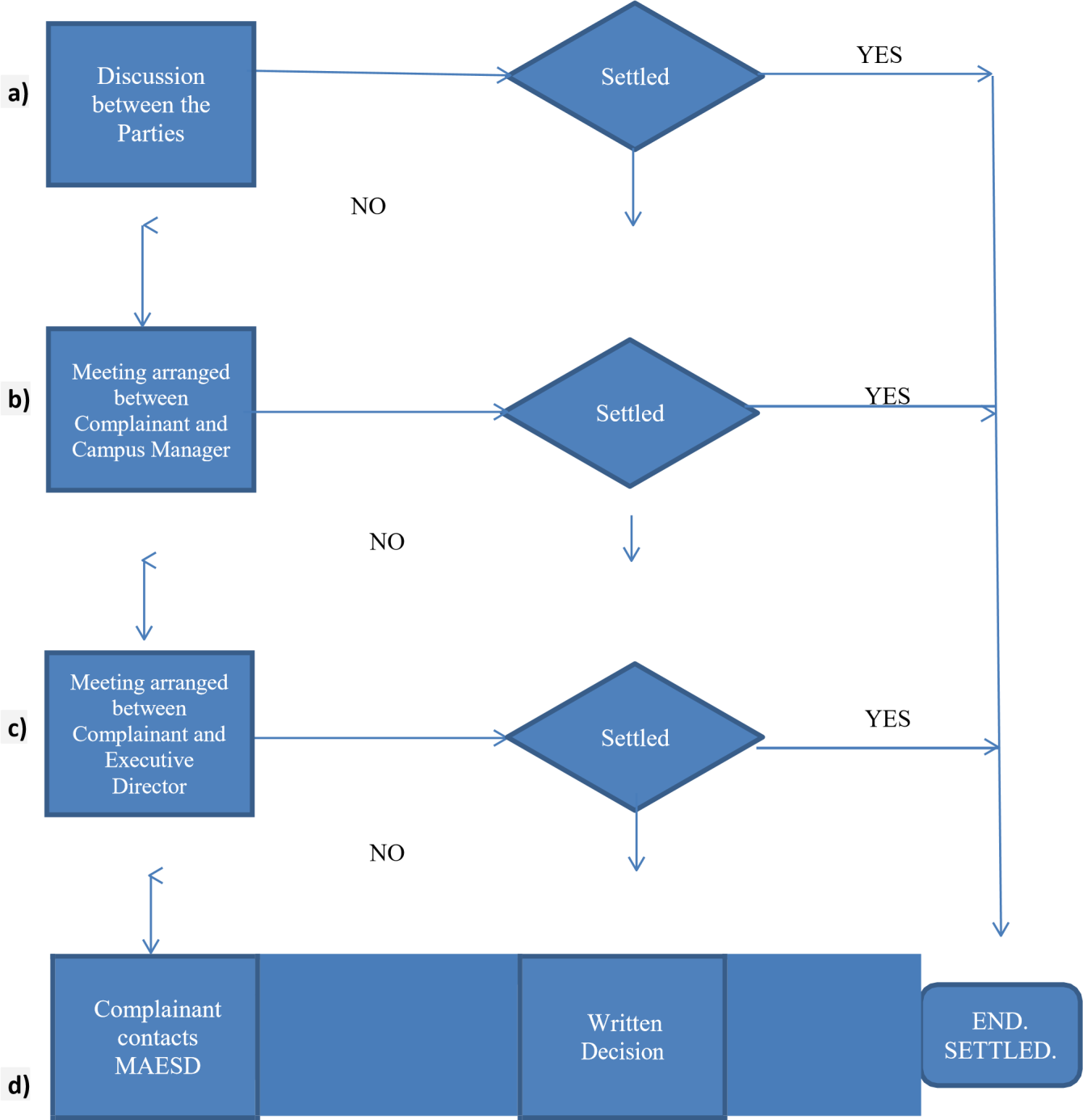
Summary of the “Student Complaint Procedure”
a) Try to resolve your concerns with the individual(s).
b) If your concern has not been resolved to your satisfaction with the individual(s), then notify the College Administration.
c) If your concern has not been resolved to your satisfaction with the College Administration, then notify the director of the College.
d) If your concern has not been resolved to your satisfaction with the director of the College, then you may notify the Superintendent, of Advanced Education & Skills Development if you are enrolled in a Vocational Program.
In all of the above steps, minutes of meetings will be maintained & signed by all parties. Students are encouraged to notify & or address any concerns immediately in writing; please do not let a minor problem develop into a major one. We assure timely identification, analysis & disposition of all student complaints for equitable resolution to the satisfaction of both the student & the College. This Student Complaint Procedure is designed for the students to follow during their training period & their training-related services.
General Guidelines:
Step I: Informal Complaint Procedure
Complaints must be brought to the notice of the College in writing by e-mail or letter to: Manager: TAHA College of Beauty, Business, Health and Technology, 2210 Markham Road, Unit 1, Scarborough, ON M1B 5V6, or studentservices@tahacollege.ca.
Students, if not satisfied with the offered solution(s) under Step I, shall follow Step II.
Step II: Formal Complaint Procedure
Students, if not satisfied with the offered solution(s) under Step II, shall follow Step III.
Step III: Appeal to the Ministry of Colleges, Universities, Research Excellence and Security, for students enrolled in a Vocational program:
A student may file a written complaint to Superintendent of Career Colleges Ministry of Colleges, Universities, Research Excellence and Security Private Institution Branch, 77 Wellesley Street West, Box 977, Toronto, ON M7A 1N3
However, if a mutually satisfying resolution cannot be reached, you have the right to take the complaint further and contact the Ministry of Colleges, Universities, Research Excellence and Security by submitting your complaint at the Program Approval & Registration Information System (PARIS). Students shall register in PARIS at this link: https://www.pcc.tcu.gov.on.ca/PARISExtWeb/public/register.xhtml with a “Student” type profile.
A copy of all complaints’ documentation must be provided to the Superintendent in the correspondence along with submitting your inquiry in PARIS
For more information on how to submit student complaints to the Superintendent of Career College, please refer to https://www.ontario.ca/page/career-college-student-complaints
For any issues with the PARIS profile, contact the Campus Administrator.
Notes:
7.2 OVERVIEW OF THE STUDENT COMPLAINT PROCEDURE
8. REFERENCES
Available online:
Available at the College:
FEE REFUND POLICY
As Prescribed under s. 24 - 33 of Reg 415/06
Fee refund policy
24. (1) The definitions set out in subsection (2) and the provisions set out in sections 25 to 33 are prescribed as provisions that a career college is required, by section 29 of the Act, to include in its fee refund policy. O. Reg. 353/23, s. 13.
(2) In sections 25 to 27,
“earned fees” means the amount of all fees paid for a vocational program that is proportional to the number of instruction hours that have taken place when a withdrawal or expulsion occurs; (“droits acquis”)
“program mid-point” means the point in the progress of a vocational program where half of the scheduled hours of instruction for the program have taken place; (“mi-parcours du programme”)
“service fee” means the lesser of 20 per cent of all vocational program fees and $500. (“frais de service”) O. Reg. 353/23, s. 13.
Full refunds
25. If a student has entered into a contract with a career college for a vocational program, the college shall give a refund of all fees paid for the program in the following circumstances:
1. The student rescinds (cancels) the contract in writing within two days of receiving a copy of it, in accordance with section 36 of the Act.
2. Before the student completes the program, the college discontinues the program or the college’s approval to provide the program is revoked by the Superintendent, but the college remains registered under the Act.
3. The college collects any fees before receiving a certificate of registration from the Superintendent.
4. The college collects any fees before the program was approved by the Superintendent.
5. The college collects any fees other than a service fee before the student has entered into a contract with the college.
6. The college expels the student in a manner or for reasons that are contrary to the college’s expulsion policy.
7. The college does not provide an evaluation, in writing, of the student’s progress as required under section 12.
8. The student voids the contract under subsection 18 (2) due to a statement, image or video made by the college that is prohibited under subsection 18 (1).
9. The student voids the contract under section 22 because it is missing a term required under section 20.
10. The student receives instruction from an instructor who is not qualified under section 41 for more than 10 per cent of the program’s duration. O. Reg. 353/23, s. 13.
Full refunds minus service fee
26. A career college shall give a refund of all fees paid for a vocational program, except the service fee, in the following circumstances:
1. The student gives written notice to the college, before the program start date specified in the student’s contract with the college, that the student is withdrawing from the program.
2. The student is admitted to the program on the condition that the student meet specified admission requirements before the program start date specified in the student’s contract with the college, and the student does not meet the requirements before that day.
3. The student does not attend the program within the first 14 days of the program after the program start date specified in the student’s contract with the college and is given written notice that the contract is cancelled from the college within the first 45 days of the program.
4. The college is notified by or on behalf of an international student before the program mid-point that the international student has not been issued a temporary resident visa as a member of the student class under the Immigration and Refugee Protection Act (Canada). O. Reg. 353/23, s. 13.
Partial refunds
27. (1) A career college shall give a student a refund of the fees paid for a vocational program in accordance with this section if,
(a) the student withdraws from the program after the program start date specified in the student’s contract with the college; or
(b) the student is expelled from the program for a reason permitted under the college’s expulsion policy. O. Reg. 353/23, s. 13.
(2) If a student’s program is scheduled to be up to 12 months in duration, the career college shall give a refund for the program as follows:
1. If the withdrawal or expulsion occurs before the program mid-point, the college shall give a refund equal to the amount of all fees paid, less the service fee and any earned fees.
2. If the withdrawal or expulsion occurs after the program mid-point, no refund is required for the program. O. Reg. 353/23, s. 13.
(3) If a student’s program is scheduled to be more than 12 months in duration, the career college shall give a refund for the initial 12-month period of the program and any subsequent period as follows:
1. If the withdrawal or expulsion occurs before half of the scheduled hours of instruction have taken place for the period, the college shall give a refund equal to the amount of all fees paid for the period, less the service fee and any earned fees.
2. If the withdrawal or expulsion occurs after half of the scheduled hours of instruction have taken place for the period, no refund is required for that period.
3. If a period has not yet started at the time of the withdrawal or expulsion, the college shall give a refund of all fees paid for that period. O. Reg. 353/23, s. 13.
Refund of compulsory fees
28. (1) A career college may only charge or collect compulsory fees in relation to a vocational program after the fees have been published by the Superintendent under subsection 43 (2). O. Reg. 353/23, s. 13.
(2) If a career college collects a compulsory fee that has not been published by the Superintendent under subsection 43 (2), the college shall give a refund of the fee to the student on written request from the student. O. Reg. 353/23, s. 13.
No retention of refund
29. A career college shall not retain any refund of fees payable to a student under sections 25 to 28 in order to recover or set-off an amount a student owes the college for any service or program other than a vocational program offered by the college. O. Reg. 353/23, s. 13.
Timing of refunds
30. A refund payable by the career college must be issued to students within 30 days after the day a student,
(a) delivers a written notice to withdraw from the program to the college;
(b) is given a written notice of expulsion by the college; or
(c) delivers a written request for a refund to the college under subsection 28 (2). O. Reg. 353/23, s. 13.
Treatment of books and equipment
31. In calculating a refund under sections 25 to 28, a career college may retain the retail cost of books or equipment that the career college supplied to the student if the student,
(a) fails to return the books or equipment to the career college within 10 days of the student’s withdrawal or expulsion from the program; or
(b) returns the books or equipment to the career college within the 10-day period referred to in clause (a), but fails to return it unopened or in the same state it was in when supplied. O. Reg. 415/06, s. 31; O. Reg. 353/23, s. 14, 22.
Notice of withdrawal for international students
32. A notice to a career college that is provided by or on behalf of an international student or of a prospective international student and that states that the student has not been issued a temporary resident visa as a member of the student class under the Immigration and Refugee Protection Act (Canada) is deemed to be written notice to the college that a student is rescinding (cancelling) the contract under section 36 of the Act or withdrawing from the program. O. Reg. 353/23, s. 15.
Currency
33. Any refund of fees that a career college is required to pay under the Act shall be paid in Canadian dollars. O. Reg. 415/06, s. 33; O. Reg. 353/23, s. 22.
ANTI-BULLYING POLICY
TAHA College of Beauty, Business, Health and Technology is committed to prohibiting all acts of Harassment or Bullying. Harassment or bullying disrupts the learning environment and impedes the College's ability to educate students in a safe atmosphere. This policy emphasizes the seriousness of harassment (or bullying) and urges both College staff and students to work collaboratively towards its elimination.
Definition:
Bullying and harassment encompass any inappropriate conduct or comment by a person towards another individual that would cause humiliation or intimidation. It includes conduct or comments that may be considered discriminatory under the Ontario Human Rights Code, involving prohibited grounds such as race, political belief, conviction for an offense, sex, color, religion, ancestry, age, physical disability, marital status, place of origin, sexual orientation, mental disability, or family status. Bullying and harassment also cover mistreatment that doesn't fall under these prohibited grounds but aims to intimidate or isolate an individual.
Examples of Conduct:
Examples of conduct or comments constituting bullying and harassment include verbal and non-verbal aggression, insults, derogatory name-calling, harmful hazing, initiation practices, and spreading malicious rumors.
Procedures:
Bullying and harassment are not only disciplinary matters but are also illegal under Canadian law. The College follows these procedures:
This policy aligns with Canadian law and ensures a safe and inclusive learning environment for all students. For additional information, refer to the Student's Handbook, specifically Section 2.13 (Rules of Conduct), the Student Expulsion Policy, and the Complaint Procedure. Additionally, adherence to the Ontario Human Rights Code is expected for professional behavior.
CONFIDENTIALITY AND PRIVACY POLICY
TAHA College of Beauty, Business, Health and Technology adheres to a strict Confidentiality and Privacy Policy, complying with laws such as the Freedom of Information and Protection of Privacy Act (FIPPA) and the Personal Health Information Protection Act (PHIPA). The policy covers the collection, use, disclosure, retention, and disposal of information related to students, employees, and service users.
1. Confidentiality and Privacy
2. Student or Employee Access to Information
3. Disclosure of Information to a Third-Party
4. Breach of Confidentiality or Privacy
Definitions:
ONLINE DELIVERY POLICY
TAHA College utilizes the Canvas Learning Management System (LMS) for the delivery of online and blended programs.
Canvas is used for:
Students will receive access to Canvas prior to the start of their program.
To access Canvas, please use the following link:
https://tahacollege.instructure.com
Students are expected to:
Students may review training materials as needed until they are comfortable using the platform.
Students must log in using their assigned college credentials:
First-Time Login Steps:
If you forget your password:
Attendance in online courses is based on both presence and active participation.
Students are considered present when they:
Camera use may be required during:
Failure to demonstrate active participation may result in:
For technical assistance, please contact:
TAHA College – Technical Support
portal@tahacollege.ca
416-609-3500
To successfully access and participate in online learning, students must have:
Access to a printer is recommended but not mandatory.
Students are responsible for maintaining the confidentiality and security of all login credentials issued to them, including usernames, passwords, and access codes used for online or hybrid learning platforms (e.g., Canvas, student email, or other College systems).
Students must:
The College does not have access to student passwords and cannot retrieve them. Students are responsible for managing their login information and must use the password reset functions where required.
Any unauthorized use of a student account, sharing of credentials, or allowing another individual to access or complete academic work on their behalf may result in disciplinary action, up to and including expulsion.
Students must:
Students are responsible for ensuring that all access to College systems accurately reflects their true identity and location at all times.
The use of VPNs, proxies, or any tools that mask, alter, or misrepresent a student’s true location, identity, or access during academic activities is strictly prohibited. Any such activity may be considered academic misconduct and may result in disciplinary action, including suspension or dismissal from the program, and may impact academic records and funding eligibility.
The College may implement identity verification measures, including but not limited to:
Any violation may result in:
TAHA College is committed to safeguarding the privacy and confidentiality of student personal information in both physical and online learning environments.
Students are also expected to respect the privacy of others and must not:
Failure to comply with privacy and confidentiality requirements may result in disciplinary action.
All student activity within Canvas and associated learning platforms may be monitored and recorded for academic, administrative, and compliance purposes.
COMPLAINT PROCEDURE POLICY
At TAHA College of Beauty, Business, Health and Technology, we value and encourage open communication. Students are urged to promptly address any concerns through the Complaint Procedure to ensure a timely and equitable resolution. This policy is designed for students to follow during their training period and related services.
General Guidelines:
Step I: Informal Complaint Procedure
Step II: Formal Complaint Procedure
Step III: Appeal to Ministry of Training, Colleges & Universities (for Vocational program students)
Students not satisfied with Step II solutions may file a written complaint with the Superintendent of Career Colleges, Ministry of Training, Colleges & Universities. The Ministry Student Complaint Form is available on the www.ServiceOntario.ca website.
This policy ensures that student concerns are addressed promptly and fairly, fostering a positive learning environment. Students are encouraged to refer to the Student Handbook for further information on rules of conduct and professional behavior.
EXPULSION POLICY
Overview:
Students at TAHA College of Beauty, Business, Health and Technology are expected to adhere to established standards of conduct, academic progress, and attendance. Failure to meet these expectations may result in expulsion. This policy outlines grounds for expulsion, the expulsion procedure, notification, appeal process, and the outcomes associated with expulsion.
Grounds for Expulsion:
Expulsion Procedure:
The college will attempt to resolve issues before expulsion, with verbal and written warnings, and suspension if necessary. The Campus Manager is responsible for issuing expulsions. Legal proceedings, if involved, will be governed by the laws of Ontario, Canada. Expulsion notifications will be in writing, providing sufficient detail.
Expulsion Appeal:
An expelled student may appeal in writing within five (5) business days from expulsion notification. Unsuccessful appeals result in withdrawal, fee refunds, no college credentials, financial responsibility for property damage, and potential legal costs.
Further Appeal:
If the expelled student disputes the expulsion decision, they can appeal to the Superintendent of Career Colleges, Ministry of Training Colleges & Universities.
This policy aims to maintain a positive learning environment and uphold academic and ethical standards. Students are encouraged to refer to the Student Handbook for additional information on conduct and policies.
If the appeal is unsuccessful, the student will be considered expelled from the college. The student will have the opportunity for further appeals through the Complaints process of the Ministry of Colleges, Universities, Research Excellence and Security by submitting the inquiry at the Program Approval & Registration Information System (PARIS). Students shall register in PARIS at this link: https://www.pcc.tcu.gov.on.ca/PARISExtWeb/public/register.xhtml with a “Student” type profile. Once they login, students shall click on Inquiry.
For any issues with the PARIS profile, students shall contact Campus Administrator.
EVALUATION & GRADING POLICIES
Absenteeism:
Remedial Plan for Failing Students:
Handling Complaints:
Student Responsibility to Raise Academic Concerns:
Students are responsible for communicating any concerns related to:
All concerns must be submitted in writing to:
studentservices@tahacollege.ca
within three (3) days of the completion of the applicable module or when the concern arises.
The purpose of this process is to allow the College to review and address concerns in a timely and appropriate manner.
Concerns raised after the stated timeframe may be subject to limited review, except in extenuating circumstances at the discretion of the College.
Final Examination:
It is essential for students to engage in timely communication and follow the outlined procedures to address concerns or file complaints regarding grades. The college is committed to a fair and transparent evaluation process.
STUDENT POLICY
1. Social Media Tagging Requirement: All parties involved in activities covered by this contract must tag the college's official social media accounts in relevant posts associated with the college on various social media platforms keeping in mind a clean presentable background.
2. Fragrance-Free Environment Policy:Scented products are prohibited on the premises covered by this contract.
3. Mandatory Hygiene Standards: Adherence to high hygiene standards, including wearing fresh clothes, clean closed-toed shoes in labs, maintaining tidy hair, ensuring fresh breath, and using deodorant.
4. Cell Phone Usage Protocol: Cell phones are expressly prohibited in classrooms or labs.
5. Recording and Photography Guidelines: Prior consent from the relevant management authority is mandatory for any recording or photography activities covered by this contract.
6. Prohibition of Harassment and Violence: Refrain from engaging in any form of harassment or violence, as stipulated in the official Student Handbook or equivalent.
7. Controversial Subjects Avoidance: Discussion of controversial subjects, including but not limited to religion and politics, is to be avoided in all interactions.
8. Prohibition of Sales and Solicitation: Prior approval from management is required for any sales or solicitation of outside services conducted within the scope of this contract.
9. Locker Responsibility: All students must assume responsibility for their assigned lockers and vacate them upon the termination of the contracted period.
10. Personal Belongings Security: All students are required to secure their personal belongings, with no liability attributed to the school or staff.
11. Beverage Policy: Only beverages in sealed containers are permissible within classrooms and labs.
12. Food and Waste Disposal: Disposal of all food and waste must be carried out in the designated breakroom garbage bins.
13. Event/Party Approval Process: Prior discussion and approval from management are prerequisites for hosting any events or parties.
14. Service Payment Terms: All students must make payment for services before the provision of said services, and communication with the relevant instructor is imperative.
15. Property/Equipment Damage Liability: In the event of damage to school property or equipment by a contracted party, the responsible party shall be obligated to cover all associated expenses.
16. Participation in Programs: Participants in specialized programs, such as Medical and Hairstyling, are obligated to act as models for their peers as part of the contractual agreement.
17. Absentee Notification Protocol: In the case of absenteeism, contracted parties must communicate with their respective instructors via email before or on the day of the absence.
18. Emergency Contact Information: Contracted parties shall provide the school number (416-609-3500) to designated caregivers, employers, and family members for emergency contact purposes.
19. Proactively Pursuing Career Opportunities: Students are required to submit their resumes to the college prior to their final exams and provide evidence of job search efforts before receiving a hard copy of their diploma.
20. Proactively Pursuing Career Opportunities: Students are required to submit their resumes to the college prior to their final exams and provide evidence of job search efforts before receiving a hard copy of their diploma.
Sexual Violence Policy
1. Applicability:
This policy applies to all members of the College community, including employees, students, instructors, contractors, suppliers of services, individuals connected to College initiatives, volunteers, and visitors. It is accessible on the College website, and a print copy is available upon request.
2. Legal Context:
This policy serves as a guide. The Criminal Code R.S.C., 1985 c. C-46, the Ontario Human Rights Code, and the Career Colleges Act 2005 take precedence and should be consulted in all cases.
3. Definitions:
Sexual Violence:
A comprehensive term encompassing any violence, physical or psychological, executed through sexual means or by targeting sexuality. Forms include sexual abuse and assault.
Consent:
The voluntary and explicit agreement to engage in a specific sexual activity. Key considerations include:
Additional points:
Note: The Criminal Code defines "consent" as the voluntary agreement to engage in sexual activity, specifying situations where consent is not obtained. It is the initiator's responsibility to ensure clear and affirmative communication at all stages of sexual engagement, including awareness of the other party's age.
4. Responsibility and Affirmative Communication:
The initiator of sexual activity is responsible for clear and affirmative communication at all stages, ensuring awareness of the other party's age.
5. Note on Consent from Criminal Code:
The Criminal Code defines consent and outlines situations where consent is not obtained.
Note: This information is as of September 2020, Version 2.1.
6. Other Relevant Terms:
Acquaintance Sexual Violence:
Age of Consent for Sexual Activity:
Coercion:
Drug-Facilitated Sexual Violence:
Stalking:
Survivor:
7. Purpose and Intent of the Policy:
All members of the College community have the right to work and study in an environment free from sexual violence. This policy outlines the College's response protocol, ensuring belief in survivors, respect for their rights, and holding individuals accountable for acts of sexual violence.
8. Policy Statement:
Sexual violence is unacceptable and will not be tolerated. The College is committed to challenging and preventing sexual violence, creating a safe space for all community members. The policy emphasizes a safe and positive environment for work, learning, and self-expression, free from sexual violence.The College is expected to be a safe and positive spacewhere members of the College community feel able to work, learn and express themselves in an environment free from sexual violence.All reported incidents of sexual violence will be investigated to the best of the administration’s ability and in a manner that ensures due process. It is this policy’s intention to make individuals feel comfortableabout making a report in good faith about sexual violence that they have experienced or witnessed. We recognize that sexual violence can occur between individuals regardless of sexual orientation, gender,and gender identity or relationship status as articulated in the Ontario Human Rights Code. We also recognize that individuals who have experienced sexual violence may experience emotional, academic or other difficulties.
The College is committed to:
9. Commitments and Actions:
10. Disciplinary Measures:
If TAHA College of Beauty, Business, Health and Technology determines that the Respondent engaged in sexual violence, immediate disciplinary or corrective action will be taken. This may include disciplinary action involving termination of employment of instructors or staff, expulsion of a student, or placement of certain restrictions on the Respondent's ability to access certain premises or facilities.
11. Reporting and Responding to Sexual Violence:
11.1 Reporting:
Members of the College community should promptly report witnessed or known incidents of sexual violence. Those who have experienced sexual violence are encouraged to come forward as soon as possible. Persons in positions of authority must take immediate action to respond to or prevent sexual violence.
11.2 Safety Measures:
If the College becomes aware of incidents of sexual violence posing a risk to the community, it will take reasonable steps to ensure safety on and off College property.
12. Complaint Process and Investigations:
12.1 Filing a Complaint:
Any member of the College community can file a complaint of sexual violence under this Policy. The College ensures procedural fairness, providing respondents with details of allegations and an opportunity to respond.
12.2 Right to Withdraw a Complaint:
A complainant can withdraw a complaint at any stage. However, the College may continue addressing identified issues to fulfill its obligations.
12.3 Protection from Reprisals, Retaliation, or Threats:
Retaliation against complainants for pursuing rights under this Policy or the Ontario Human Rights Code is strictly prohibited. Sanctions and discipline may apply to those engaging in such conduct.
12.4 Addressing Complaints:
Confiding in Someone:
12.5 Unsubstantiated or Vexatious Complaints:
If a person, in good faith, discloses or files a sexual violence complaint that is not supported by evidence gathered during an investigation, that complaint will be dismissed. Disclosures or complaints that are found following investigation to be frivolous, vexatious or bad faith complaints, that is, made to purposely annoy, embarrass or harm the respondent may result in sanctions and/or discipline against the complainant.
13. Making False Statements:
It violates this Sexual Violence Policy for anyone to knowingly make a false complaint of sexual violence or provide false information about a complaint. Individuals who violate this Sexual Violence Policy are subject to disciplinary and/or corrective action up to and including termination of employment of instructors or staff or expulsion of a student.
14. Confidentiality:
The confidentiality of all persons involved in a report of sexual violence must be strictly observed, and the College does its best to respect the confidentiality of all persons, including the complainant, respondent, and witnesses.
However, confidentiality cannot be assured in the following circumstances:
1. An individual is at imminent risk of self-harm.
2. An individual is at imminent risk of harming another.
3. There are reasonable grounds to believe that others in the College or wider community may be at risk of harm.
In such circumstances, information would only be shared with necessary services to prevent harm, and the name of the survivor would not be released to the public.
Where the College becomes aware of an allegation of sexual violence by a member of the College community against another member, the College may also have an obligation to take steps to ensure the matter is addressed to comply with legal obligations and/or policies. In such cases, certain College administrators will be informed about the reported incident on a “need to know” and confidential basis, though not necessarily with the identities of the persons involved.
If students, in good faith, report an incident or make a complaint about sexual violence, they will not be subject to discipline or sanctions for any violations of the College’s policies relating to drug or alcohol use at the time the alleged incident occurred.
Students who disclose their experience of sexual violence through reporting an incident, making a complaint, or accessing supports and services will not be asked irrelevant questions during the investigation process, including questions about their sexual expression or past sexual history.
16. Sexual Assault & Sexual Violence Protocol:
If You Have Experienced Sexual Violence:
If you have experienced sexual violence, please contact the College Manager immediately at
416-609-3500. It can be challenging to disclose and report incidents of sexual violence, and the decision to
do so is entirely up to you. However, reporting is strongly encouraged. You are not required to report to
obtain support, services, or accommodation. Several resources are available to you, including:
| Table 1: Emergency Contacts for Sexual Violence Support | |||
Resource Name | Location | Phone Number | Service Provided |
| Good2Talk – Ontario Post-Secondary Student Helpline | All Provinces | 1-866-925-5454 | 24/7 helpline for students |
| Toronto Rape Crisis Centre | Toronto | (416) 597-8808 | Crisis support and counselling |
| Women’s Support Network of York Region | York Region | 1-800-263-6734 | Sexual violence support services |
| Hope 24/7: Sexual Assault Centre of Peel | Peel Region | 1-800-810-0180 | Sexual violence support services |
| Durham Rape Crisis Centre | Durham Region | 905-668-9200 | Sexual violence support services |
| Table 2: Sexual Assault/Domestic Violence Treatment Centres (Ontario) | |||
Service | Details | ||
| Emergency Medical Care | Immediate healthcare support after assault. | ||
| Crisis Intervention | Support during emotional and psychological distress. | ||
| Collection of Forensic Evidence | Evidence gathering for potential legal action. | ||
| Emergency Contraception & STI Prevention | Access to contraception and infection prevention. | ||
| Medical Follow-up | Ongoing healthcare after initial treatment. | ||
| Counselling | Individual counselling to process trauma. | ||
| Table 3: Ontario Sexual Assault/Domestic Violence Treatment Centre Contact Information | ||
| Network Name | Phone Number / Website | Address |
| Ontario Network of Sexual Assault/Domestic Violence Treatment Centres | 76 Grenville Street, Toronto, ON M5S 1B2 | (416) 323-7327 www.satcontario.com |
| Table 4: Relevant Legal and Policy References | |
| Policy/Act | Website/Reference Link |
| Career Colleges Act, 2005 | https://www.ontario.ca/laws/statute/05p28 |
| Criminal Code of Canada (R.S.C., 1985, c. C-46) | https://laws-lois.justice.gc.ca/eng/acts/C-46/ |
| Ontario Human Rights Code | https://www.ontario.ca/laws/statute/90h19 |
| Occupational Health and Safety Act | https://www.ontario.ca/laws/statute/90o01 |
17. Review and Amendment:
The sexual violence policy will undergo a review at least once every three years, with amendments made
as necessary to ensure its effectiveness and alignment with current best practices.
18. Reprisal:
It is a violation of this Sexual Violence Policy to retaliate or threaten to retaliate against a complainant who
has brought forward a complaint of sexual violence, provided information related to a complaint, or
otherwise been involved in the complaint investigation process. Individuals who violate the Sexual Violence
Policy are subject to disciplinary and/or corrective action, up to and including termination of employment of
instructors or staff or expulsion of a student.
DAMAGE CONTROL AND RESPONSIBILITY POLICY
1. Acknowledgment of Responsibility:
2. Locker Maintenance:
3. Care and Respect for College Property:
4. Reporting Damage:
5. Personal Responsibility for Damage:
6. Cooperation with Investigations:
7. Financial Responsibility:
8. Impact on College Community:
9. Binding Policy:
TAHA College of Beauty, Business, Health and Technology shall collect and be prepared to provide upon request by the Superintendent of Career Colleges such data and information as required according to Subsections 32.1 (8), (9), (10), and (11) of Schedule 5 of the Career Colleges Act, 2005 as amended.