Have Query ? Reach Out Us!

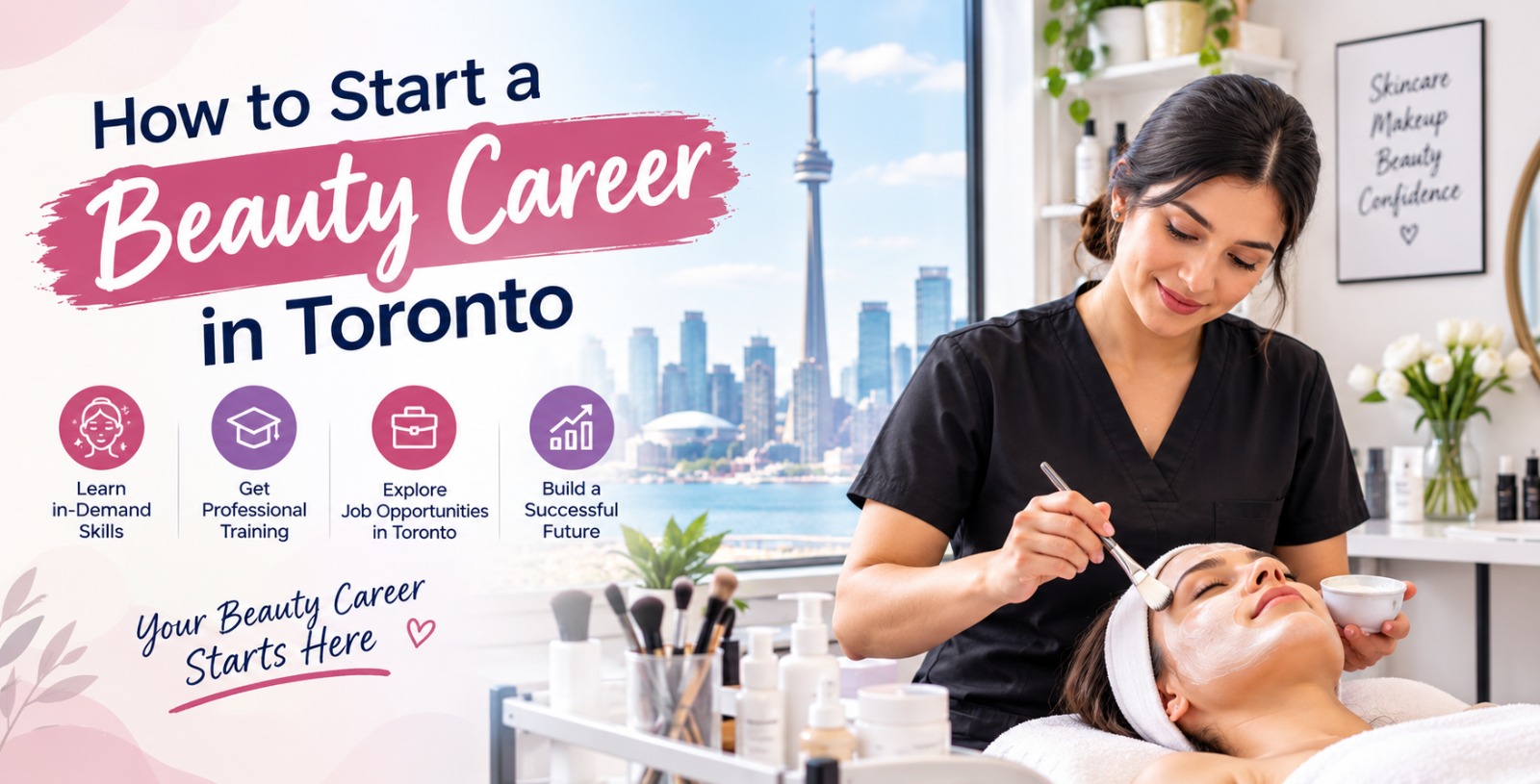
How to Start a Beauty Career in Toronto
By the TAHA College Admissions Team · Information checked October 2026
To start a beauty career in Toronto, you choose a path (hair, esthetics, makeup, nails or medical aesthetics), learn the Ontario rules for that path, train with a college that gives you real hands-on practice, build a portfolio, and then apply for your first job or start taking clients. The steps are simple. What trips people up is that the rules differ between paths. In Ontario, hairstyling is a compulsory trade and esthetics is not, and that changes what you need to do first.
This guide walks you through each step in plain language, shows what training can look like, and explains why TAHA College is a strong place to begin.
"Beauty" covers several different careers, each with its own training, rules and daily routine. Choose the one that fits how you like to work.
| Path | What you do | Ontario rules | Typical workplaces |
|---|---|---|---|
| Hairstylist | Cut, colour and style hair, consult with clients | Compulsory trade. A certificate of qualification or an apprenticeship is needed to work (see Step 2) | Salons, studios, film and TV sets, events |
| Esthetician | Skin care, facials, waxing, makeup, nail care | Not on the compulsory trades list. Career college students are told that graduates cannot perform controlled acts | Spas, salons, skin clinics |
| Medical aesthetics | Advanced skin care in a clinical setting, within legal limits | Same esthetics limits. Procedures that count as controlled acts need a qualified health professional | Medical spas, dermatology and aesthetic clinics |
| Makeup artist | Bridal, editorial, film, retail and event makeup | Not a compulsory trade | Freelance, retail beauty, production crews |
| Nail technician | Manicures, pedicures, extensions, nail art | Not a compulsory trade | Nail studios, spas, self-employed |
| Lash and brow artist | Eyelash extensions, brow shaping and microblading | Check current rules and insurance requirements before you start | Studios, spas, self-employed |
Ask yourself three questions. Do you want a steady salon or clinic job, or your own client list? Do you enjoy science and skin health, or creative and artistic work? Do you want to start earning quickly, or invest in a longer program?
Not sure yet? A broader program is a good way to explore. TAHA College's Aesthetics Diploma covers skin care, makeup artistry, waxing and nail care, so you can try several areas before you specialise. The Medical Aesthetics Diploma goes deeper into clinical skin care, and the Hairstyling Diploma is built for people who already know hair is their calling.
This is the step most beginner guides skip, and it can save you time and money.
Do you need a licence to be a hairstylist in Ontario?
In practice, yes. Hairstylist is a compulsory trade in Ontario. To work as one, you must hold a Certificate of Qualification or a Provisional Certificate of Qualification, or work as an apprentice under a valid Registered Training Agreement. Skilled Trades Ontario handles apprenticeship and certification. A school diploma on its own does not authorise you to work as a hairstylist, so before you enrol anywhere, ask how the program fits into the certification route. TAHA's admissions team is happy to walk you through this before you commit.
What about estheticians and makeup artists?
Esthetician is not on Ontario's compulsory trades list. However, career colleges that teach esthetics follow a Ministry directive that requires students to be told that graduates cannot perform controlled acts. These include injections, procedures below the dermis and applying certain forms of energy. Procedures like these need a qualified health professional. A good esthetics or medical aesthetics program will tell you clearly, before you enrol, what you will and will not be able to do after graduation. Ask for that in writing at any school you consider.
How do you check a school?
Before you pay a deposit, look at the school's published results. You can see TAHA College's graduation and employment results on the Ministry's career college data page. Do the same for every school on your shortlist.
You can pick up some beauty skills through short courses, but most employers prefer formal training with supervised practice. When you compare schools in Toronto, ask:
What training looks like at TAHA College
| Program | Length | Delivery |
|---|---|---|
| Medical Aesthetics Diploma | 64 weeks / 1,240 hours | Hybrid, Toronto and Brampton campuses |
| Hairstyling Diploma | 63 weeks / 1,500 hours | Hybrid, Toronto and Brampton campuses |
| Aesthetics Diploma | About 40 weeks | Hybrid |
To apply, you need an Ontario Secondary School Diploma or equivalent, or be at least 18 years old and pass an entry test. Start dates are ongoing, so you do not have to wait for a single September intake.
If you want to start with something shorter, TAHA also offers certificate courses, including professional makeup, nail technician, eyelash extension, waxing, microblading, microdermabrasion, laser hair removal and photo rejuvenation. You can start with one course and build from there.
Choosing where to train is the biggest decision on this list. Here is what TAHA College offers beauty students in Toronto.
25 years of education experience - TAHA College has been helping students build careers in beauty, business, health and technology for 25 years.
Hands-on learning - The Medical Aesthetics and Aesthetics programs are built around practical exercises and real-world simulations, and the Hairstyling program includes practical workshops, live demonstrations and supervised salon sessions. The Medical Aesthetics and Hairstyling programs include practicum components so you practise what you learn.
Personal guidance from your instructors - Our instructors give personalized guidance, so you can refine your technique, build confidence and ask questions as you go.
Flexible, hybrid delivery - Combine online learning with practical sessions on campus. The Hairstyling Diploma also offers both full-time and part-time schedules, which helps if you are working or raising a family.
Ongoing start dates - You can begin when you are ready instead of waiting months for a fixed intake.
Two campuses - Study at our Toronto or Brampton campus.
A clear starting point - Entry requires an Ontario Secondary School Diploma or equivalent, or being 18 or older and passing an entry test. No previous beauty experience is needed for the Aesthetics Diploma.
Financial aid for eligible students - Funding may be available, and our team can explain your options. See our financial aid page.
Support for international students and newcomers - International students are welcome to apply, and our team helps with the transition. Read more on our international students page.
A place to keep growing - After your diploma, short certificate courses let you add services such as lashes, waxing or microblading.
Clients and employers trust what they can see.
Practise on a range of people - Work on different skin tones, hair textures, ages and face shapes. Toronto is one of the most diverse cities in Canada, and your clients will be too.
Document your work - Take clear before-and-after photos in good light, with client consent. Keep a simple portfolio on Instagram or a one-page website.
Learn the business basics early - Sanitation, client consultation, record keeping and pricing matter as much as technique.
Ask for feedback - from instructors and every early client, and write down what you would repeat or change.
Toronto offers several routes into beauty work:
Salons and spas: a steady schedule and a client base that is built for you. Good for learning fast.
Medical aesthetics and skin clinics: suits graduates of clinical programs. Be clear about which services you can perform.
Film, TV and events: makeup and hair assistants often start by assisting an established artist.
Bridal and event work: usually freelance, built on referrals and your portfolio.
Self-employment: you rent a chair or a room, or work mobile.
Tips for finding your first role
If you plan to work for yourself: register your business, get liability insurance, and check the Canada Revenue Agency's GST/HST rules for businesses to find out when you must register. Good record keeping from day one makes tax time easier.
If you are new to Canada: Canadian experience matters to many employers, so a local practicum, a reference from an instructor and a portfolio of Toronto clients can help. Check whether your study permit or work permit allows the work you want to do.
Beauty changes fast, and the people who stay busy keep learning.
Add a short course (lashes, waxing, microblading, advanced makeup) to widen your services.
Move from general aesthetics into a specialty, such as skin treatments, bridal or hair colour.
Attend workshops, follow industry news and keep your sanitation and first-aid training current.
Review your prices and your client list every six months.
| When | Focus | Output |
|---|---|---|
| Month 0 to 1 | Choose your path, check Ontario rules, shortlist 2 to 3 schools | Notes from school visits and answers to the 8 questions |
| Month 1 to 3 | Apply, arrange funding or financial aid, enrol | A confirmed start date and budget |
| During training | Practise often, build a portfolio, ask about practicums | A strong set of portfolio pieces and instructor references |
| After training (months 1 to 3) | Apply for jobs, assist, offer trial shifts | First paid work or first regular clients |
| Months 4 to 12 | Build a client base, ask for reviews, add a skill | Repeat clients, a stronger portfolio, a plan for year two |
| Question | Short answer |
|---|---|
| How long does training take? | Short certificate courses can take weeks. TAHA's diploma programs run about 40 weeks for Aesthetics, 63 weeks for Hairstyling and 64 weeks for Medical Aesthetics. Hairstyling certification also depends on the apprenticeship pathway. |
| How much does it cost? | Costs depend on the program. Call or email our admissions team for current fees and what is included, and ask about financial aid for eligible students. |
| What can you earn? | Pay varies by occupation, experience, employer and tips or commission. For current wages in Toronto and Ontario, check the Government of Canada Job Bank wage pages for hairstylists and for estheticians and related occupations. |
1. How do I start a beauty career in Toronto with no experience?
Choose a path, check the Ontario rules for it, and enrol in training with a college that gives you hands-on practice. Most programs accept beginners. Then build a portfolio and apply for entry-level or assistant roles. TAHA's Aesthetics Diploma does not require previous beauty experience.
2. Do I need a licence to work in beauty in Ontario?
It depends on the path. Hairstylist is a compulsory trade, so you need a certificate of qualification or an apprenticeship to work legally. Esthetician is not on the compulsory trades list, but esthetics graduates cannot perform controlled acts. Check the rules for your specific path, and ask us if you are not sure.
3. How long does it take to become an esthetician in Toronto?
It depends on the program. At TAHA College, the Aesthetics Diploma runs about 40 weeks and the Medical Aesthetics Diploma runs 64 weeks (1,240 hours). Short certificate courses are quicker but cover fewer services.
4. What is the difference between aesthetics and medical aesthetics?
Aesthetics covers services like skin care, makeup, waxing and nail care. Medical aesthetics adds clinical skin care, including topics like skin anatomy, chemical peels and microdermabrasion, in settings such as skin clinics. In both, procedures that are controlled acts are outside what graduates can perform.
5. Can a makeup artist work without a diploma?
Makeup artistry is not a compulsory trade, so there is no licence requirement. Training still helps with technique, hygiene and building a portfolio that wins clients. TAHA offers a professional makeup course as well as the Aesthetics Diploma, which includes makeup artistry.
6. Can I become a hairstylist in Toronto just by finishing a diploma?
Not on its own. You also need to work toward or hold a certificate of qualification, normally through apprenticeship. Talk to our admissions team about how the Hairstyling Diploma fits into that route.
7. Is it too late to start a beauty career in my 30s or 40s?
No. Many people start later or switch careers into beauty. TAHA's diploma programs are open to anyone who is 18 or older and meets the entry requirements, and flexible hybrid delivery makes it easier to study around work and family.
8. Can international students and newcomers study beauty in Toronto?
Yes. International students are welcome to apply to TAHA College, and our team helps with the transition. Check your study or work permit rules and the admission requirements, and see our international students page.
You do not need to have it all figured out. Talk to our admissions team about which path fits you, how the programs work, what you need to apply and when you can start.
Call: +1 416 609 3500 or +1 905 799 7570
Email: admissions@tahacollege.ca
WhatsApp: Message us
Explore programs: TAHA College programs
Your beauty career in Toronto can start with one conversation. Contact TAHA College today and take the first step.
This guide is general information and not legal or career advice. Rules and requirements can change, so check the linked government sources and confirm details with the college before enrolling.
Have a Question? Ask Us!
Related Blogs













.png 1.png "https://www.tahacollege.ca/storage/blog/1755679660-Untitled (720 x 540 px).png 1.png")











.png "https://www.tahacollege.ca/storage/blog/1755606017-Untitled (720 x 540 px).png")





.png "https://www.tahacollege.ca/storage/blog/1757745482-psw skills (1).png")