Have Query ? Reach Out Us!

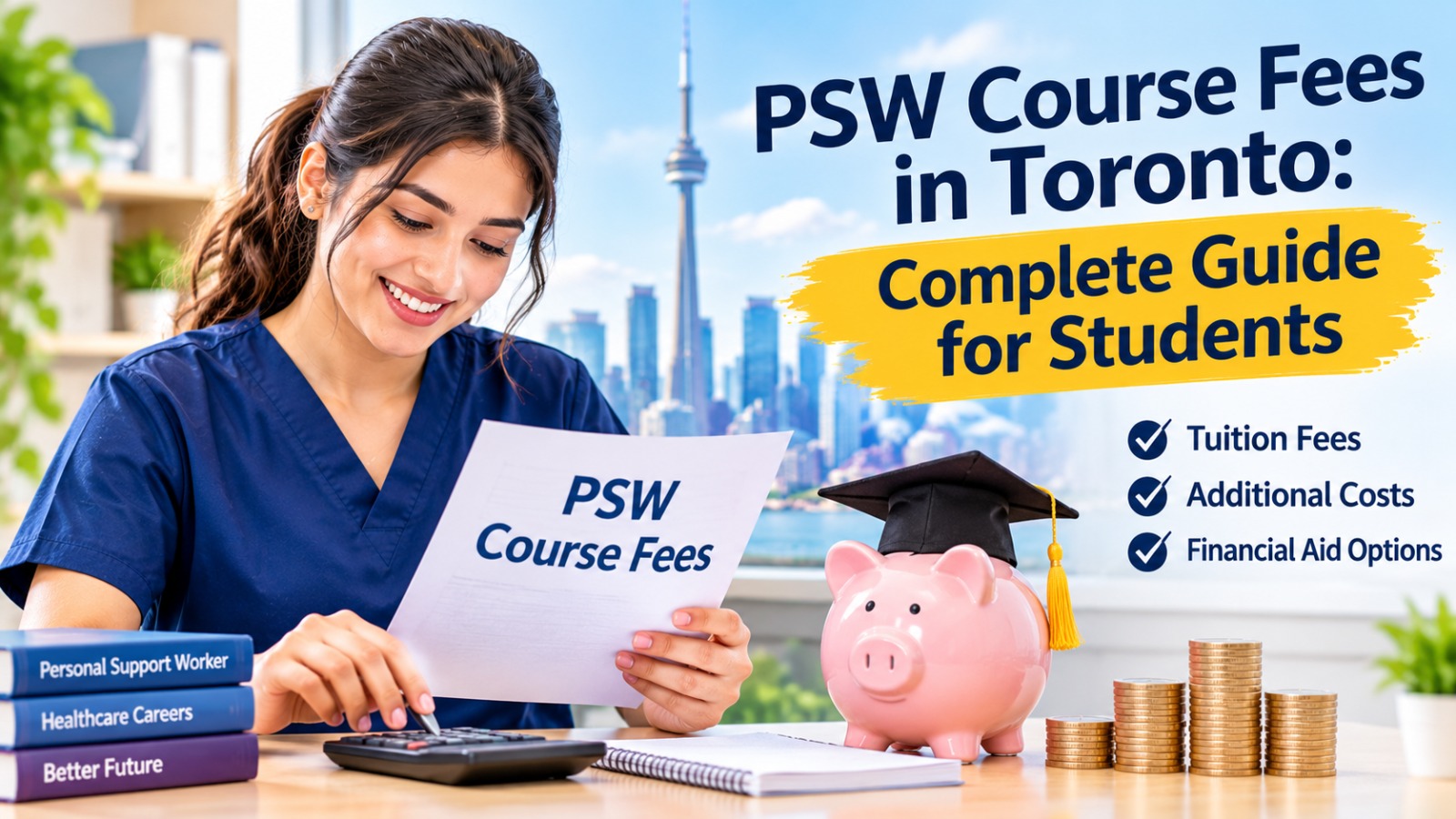
PSW Course Fees in Toronto: Complete Guide for Students
By Guest Post, TAHA College · Fees last checked 24 November 2026
Most articles on PSW course fees in Toronto give you one number, usually the tuition, and stop there. That number is the least useful one. It isn't what you'll pay, it isn't what OSAP will cover, and since August 2026 it doesn't even tell you whether a cheap program is actually cheap.
So this guide does three things differently. It shows the real 2026-27 fees straight from the schools' own pages. It walks you through the costs nobody puts on the brochure. And it explains how this year's OSAP changes flipped the math between public colleges and private ones.
A quick word on who we are. We're TAHA College, a registered career college with campuses in Scarborough and Brampton, and we've been teaching for over 25 years. We run a NACC Personal Support Worker program in a hybrid format: 35 weeks and 700 hours. We wrote this guide because students kept asking us how our fees compare, and we'd rather you compare honestly, with real numbers from every school, before you decide. If you want to know TAHA College's own PSW fees, contact us or fill in the enquiry form at www.tahacollege.ca.
The quick answer
For a domestic student, a PSW course in Toronto costs roughly $3,700 to $7,200 at a private career college and roughly $4,000 to $4,500 in tuition and fees at a public college, before books and other costs. International students at public colleges pay roughly $19,000 to $20,000 for the full program.
But the cheapest sticker price isn't automatically the cheapest program for you. Keep reading for why.
These figures come from each school's own website. All of them say fees are estimates and can change.
| School | Type | Length | Domestic cost | International cost |
|---|---|---|---|---|
| Centennial College | Public college | 2 semesters | $2,775 tuition + $1,679.47 ancillary = $4,454.47 | $18,005 tuition + $2,191.12 ancillary = $20,196.12 |
| Seneca Polytechnic | Public college | 2 semesters | $2,209.17 per semester in tuition and ancillary fees, plus about $415 for books | $9,766.52 per semester, plus about $415 for books |
| George Brown | Public college | 2 semesters | about $4,020 to $4,200, books extra | about $19,178 |
| ABM College (Scarborough) | Private career college | 28 weeks, 300 placement hours | $3,700 tuition | Ask the school |
| Medix College | Private career college | 27 weeks, 300 externship hours | $6,055 tuition + $850 lab + $195 books + $90 uniform = $7,190 | Ask the school |
| TAHA College (Scarborough, Brampton) | Career college, NACC program | 35 weeks, 700 hours, hybrid | Contact us for current fees | Contact us |
Our fees depend on your start date, whether you study as a domestic or work-permit student, and the funding you qualify for, so we give you an exact, all-in figure rather than a headline number. Call our Scarborough campus on +1 416 609 3500, email admissions@tahacollege.ca, or fill in the enquiry form at www.tahacollege.ca and our admissions team will send you the full breakdown.
A few things jump out once you line them up.
Tuition is only part of a public college bill. At Centennial, the tuition is $2,775, but ancillary fees add another $1,679. That's close to 40% of the total. Those fees pay for things like student services and health and counselling, so they aren't wasted, but they're easy to miss if you only read the tuition line.
Seneca quotes per semester, others quote per program. Seneca's $2,209 is for one semester. Double it for a full-time, two-semester program. Comparing Seneca's per-semester number with another school's full-program number is an easy mistake to make, and it makes Seneca look half the price it really is.
Private programs are shorter. ABM and Medix run about 27 to 28 weeks. A public college certificate is two semesters. A shorter program can mean you start earning sooner, which matters as much as the fee itself.
Humber also runs a PSW certificate in Toronto. Its fees are on Humber's program page. Check the year you're applying for, because older figures still show up in search results.
Every PSW program includes a clinical placement in a long-term care home, hospital or community setting. Before you're allowed onto the floor, you'll usually need some or all of the following. Some schools include a few of these in their fees. Most don't.
Use this as a worksheet. Ask your school which ones are included, then fill in your own numbers.
| Cost | Who usually pays | Your number |
|---|---|---|
| Vulnerable sector check (police check) | You | $ |
| Immunizations and TB test | You | $ |
| CPR and First Aid certificate | You, unless included | $ |
| N95 mask fit test | You, unless included | $ |
| Uniform or scrubs and safe, closed-toe shoes | You, unless included | $ |
| Textbooks and e-texts | You, unless included | $ |
| Transit to placement (it may not be near your home) | You | $ |
| Hours of paid work you'll give up during placement | You | $ |
| Your real total | $ |
That last row matters more than people think. Placement is unpaid, it often runs on fixed shifts, and in a city the size of Toronto it can be a long TTC ride away. If you're working while you study, ask early how many placement hours there are and how shifts are scheduled.
This is the part most fee guides haven't caught up on.
From August 1, 2026, Ontario changed how OSAP is split between grants and loans. The share of provincial aid that comes as a non-repayable grant dropped to a maximum of 25%, with the rest as loans. And students at private career colleges can now only get loans through OSAP, not provincial grants. CBC has a clear summary of the changes.
Here's what that means in practice.
A private program with a $3,700 tuition might look cheaper than a $4,454 public one. But if you rely on OSAP, the public college student may still get part of their aid as a grant they never pay back. The private college student borrows all of the provincial portion. Depending on your situation, the "cheaper" program can end up costing you more once you've repaid the loan.
There's no single right answer, because it depends on your income, your family situation and how fast you want to start working. What you should do is run both options through the OSAP calculator on ontario.ca before you choose. If you're looking at a private college, also ask the admissions office directly whether OSAP funding for their program is currently being processed normally, since there were reports of disruptions at private institutions this fall.
If you're an international student
The gap here is huge. Public college PSW programs in Toronto cost roughly $19,000 to $20,000 in tuition and fees for international students, against about $4,500 for domestic students.
Post-graduation work permit (PGWP) eligibility. Seneca lists its PSW program as PGWP-eligible, and Centennial lists its program as "PGWP Aligned: Yes". Private career college programs are generally not eligible for a PGWP. If staying to work in Canada after graduation is part of your plan, confirm this in writing with the school and on the IRCC website.
Living costs and health insurance. These are on top of tuition and are usually much bigger than the course fee itself. Seneca, for example, bills international health insurance separately.
Here's a simple way to think about it. Take your real total from the worksheet above, and divide it by what you expect to take home per hour after tax as a PSW.
For example, if your real total is $5,500 and you take home $20 an hour, that's 275 hours of work, or about seven weeks full time. (These numbers are only an illustration. Check current PSW wages for Toronto on Job Bank and use your own.)
Seen that way, the difference between a $3,700 and a $4,500 program is about 40 hours of work. The difference between finishing in 28 weeks and in two semesters can be bigger than that. So don't choose on fee alone. Choose on fee, length, placement quality, and whether employers in your area hire from that school.
OSAP. Still the main route for most domestic students, even after the 2026 changes. Apply early.
Better Jobs Ontario. If you've been laid off, this program may cover tuition, books and other costs. Check eligibility on ontario.ca.
School board continuing education. Some Ontario school boards run PSW programs that follow the same provincial standard. Ask your local board about fees and start dates.
College bursaries and awards. Public colleges list them on their financial aid pages. They're small but worth the application.
Employer sponsorship. Some long-term care homes and home care agencies help pay for training in return for a work commitment. Read the commitment terms carefully.
Newcomer loans. Organisations such as Windmill Microlending offer low-interest loans to immigrants and refugees for training costs.
If a school won't answer these clearly, that tells you something. Ask us all seven too. Our admissions team will answer each one in writing.
After you graduate: one cost you won't have, for now
Once you finish an Ontario PSW program, you can register with the Health and Supportive Care Providers Oversight Authority (HSCPOA). Registration is currently voluntary, and HSCPOA says there's no cost to apply, register or renew. Some employers ask for it, though, and the province can introduce fees later. Students don't need to register while they're still in the program.
How much is a PSW course in Toronto?
For domestic students, roughly $3,700 to $7,200 at private career colleges and about $4,000 to $4,500 in tuition and fees at public colleges, before books and placement costs. International students pay roughly $19,000 to $20,000 at public colleges.
What's the cheapest PSW course in Toronto?
On sticker price, some private career colleges are lowest. But since August 2026, private college students get only loans from OSAP, so a public college can work out cheaper for students who rely on OSAP. Compare your real total, not tuition.
Is a PSW course covered by OSAP?
Many PSW programs are OSAP-eligible. Public college students can get a mix of grants and loans. Private career college students can now only get loans through OSAP.
How long is a PSW course in Toronto?
Public college certificates take two semesters. Private career college programs we checked run about 27 to 28 weeks, including around 300 hours of placement.
Why do PSW fees differ so much between schools?
Public colleges add ancillary fees on top of tuition. Private colleges often bundle or separately list lab, book and uniform fees. Some schools quote per semester, others per program. Always compare total cost for the full program.
Do I need to pay to register as a PSW in Ontario?
Not at the moment. HSCPOA registration is voluntary and currently free, though that could change.
How much is the PSW course at TAHA College?
It depends on your start date, your student status and the funding you qualify for. Call us on +1 416 609 3500, email admissions@tahacollege.ca, or fill in the enquiry form at www.tahacollege.ca, and we'll send you the full, all-in cost.
Ask us about TAHA College's PSW fees
If you've read this far, you're comparing seriously, and that's exactly what you should be doing. When you're ready to see our numbers next to the ones above, get in touch. We'll give you the total cost in writing, including what's covered and what isn't, and help you check which funding you may qualify for.
Fill in the enquiry form at www.tahacollege.ca · Contact us · +1 416 609 3500 · admissions@tahacollege.ca
TAHA College · Scarborough campus: 2210 Markham Road, Unit 1, Scarborough, ON M1B 5V6 · Brampton campus: 2565 Steeles Ave. East, Brampton
Have a Question? Ask Us!
Related Blogs














.png 1.png "https://www.tahacollege.ca/storage/blog/1755679660-Untitled (720 x 540 px).png 1.png")












.png "https://www.tahacollege.ca/storage/blog/1755606017-Untitled (720 x 540 px).png")





.png "https://www.tahacollege.ca/storage/blog/1757745482-psw skills (1).png")